Separable verbs
die trennbaren Verben
Separable verbs are German compound verbs whose prefix splits off and moves to the end of the sentence: Ich rufe dich an.
Ich rufe dich an — the verb split in two and one half ran to the end of the sentence. English has a few of these (“I’ll call you up”), but German does it constantly and with a fixed rule. Which prefixes split, the stress clue that tells you, and the separable verbs you will meet every day.
The verb splits in two
ShortcutIf the prefix is stressed, it splits off and goes to the end of the sentence: anrufen → ich rufe dich an.
In the dictionary it is one word: anrufen — “to call (by phone)”. Once you build a sentence it comes apart: the conjugated part sits in second position, the prefix goes to the very end.
Ich rufe dich morgen an.
I’ll call you tomorrow.
Ich anrufe dich morgen.
Wrong — the prefix does not stay in place.
You have already seen this frame with modal verbs: one end opens in second position, the other end closes the sentence (Satzklammer). The difference: there the last word was a second verb; here it is the other half of the same verb.
That is why, when you listen to German, you have to wait for the end of the sentence. Ich rufe dich… could be shouting (rufen = to call out) or phoning (anrufen). The last word decides.
Which prefixes split, which never do
There are two short lists to memorise. The prefixes that never split are only seven or eight — learn those, and everything else splits.
| Splits | Example | Never splits | Example |
|---|---|---|---|
| an- | anrufen · to call | be- | bekommen · to get |
| auf- | aufstehen · to get up | ge- | gehören · to belong |
| aus- | ausgehen · to go out | er- | erklären · to explain |
| ein- | einkaufen · to shop | ver- | verstehen · to understand |
| mit- | mitkommen · to come along | zer- | zerstören · to destroy |
| Splits | Example | Never splits | Example |
|---|---|---|---|
| ab- | abfahren · to depart | ent- | entscheiden · to decide |
| zu- | zumachen · to close | emp- | empfehlen · to recommend |
| vor- | vorstellen · to introduce | miss- | missverstehen · to misunderstand |
| zurück- | zurückkommen · to come back | ||
| weg- · los- · hin- · her- | weggehen · losfahren |
The ones that never split are all syllables that mean nothing on their own: be- · ge- · er- · ver- · zer- · ent- · emp- · miss-. The ones that split are prepositions and adverbs you already know: an · auf · aus · ein · mit · ab · zu · vor.
Use your ear: where is the stress?
You can know it without memorising a list — the prefix that splits is stressed. When you hear a German speaker, notice which part of the word they lean on.
| Word | Stress | Splits? | In a sentence |
|---|---|---|---|
| anrufen | AN·rufen | yes | Ich rufe an. |
| aufstehen | AUF·stehen | yes | Ich stehe auf. |
| verstehen | ver·STE·hen | no | Ich verstehe. |
| bekommen | be·KOM·men | no | Ich bekomme. |
Two verbs from the same root: aufstehen (to get up, splits) and verstehen (to understand, does not split). English does the same with stress — REcord vs. reCORD. It is not a rule you look up; the stress tells you.
The prefix rewrites the meaning
Do not treat the prefix as a “detail” — it decides what the word means. English does this with give up · give in · give away · give back. From one verb you get five different ones:
| Root | + prefix | Meaning | Example |
|---|---|---|---|
| kommen · to come | ankommen | to arrive | Der Zug kommt um 8 an. |
| mitkommen | to come along | Kommst du mit? | |
| zurückkommen | to come back | Ich komme gleich zurück. | |
| machen · to make, to do | aufmachen | to open | Mach bitte das Fenster auf. |
| zumachen | to close | Ich mache die Tür zu. | |
| mitmachen | to join in | Machst du mit? | |
| stehen · to stand | aufstehen | to get up | Ich stehe um 6 auf. |
| fangen · to catch | anfangen | to begin | Der Kurs fängt an. |
In your vocabulary notebook write the whole verb, not the root — ankommen, mitkommen. If you try to work it out as “kommen + an”, you will freeze mid-sentence.
Four traps — when it does not split
With a modal verb, it stays whole
Ich muss dich anrufen.
I have to call you. → the verb stays whole, at the end
Ich muss dich rufe an.
Wrong.
The reason is simple: a verb that is not conjugated does not split. In a modal sentence the conjugated verb is muss; anrufen goes to the end as an infinitive and stays in one piece.
In a subordinate clause, it does not split either
Ich weiß nicht, ob er heute ankommt.
I don’t know whether he’s arriving today.
…, weil ich früh aufstehe.
…because I get up early.
In a subordinate clause the conjugated verb goes to the end anyway — and there the prefix joins it again: an + kommt = ankommt. It is not written apart.
In the Perfekt, -ge- goes in the middle
Ich habe dich angerufen.
I called you.
Ich bin um 6 aufgestanden.
I got up at 6.
In the Partizip II the syllable -ge- is squeezed in between the prefix and the root: an·ge·rufen · ein·ge·kauft · mit·ge·bracht. Inseparable verbs have no -ge- at all: verstanden, bekommen.
zu goes in the middle, too
Ich habe vergessen, dich anzurufen.
I forgot to call you.
Es ist Zeit, aufzustehen.
It’s time to get up.
In a zu + infinitive construction, zu also slips into the middle and the verb is written as one word: anzurufen, einzukaufen. With an inseparable verb, the zu stays in front as usual: zu verstehen.
15 verbs you will need ten times a day
| Verb | Meaning | In a sentence |
|---|---|---|
| aufstehen | to get up | Ich stehe um 7 auf. |
| anfangen | to begin | Der Film fängt um 8 an. |
| aufhören | to stop, to quit | Hör auf! |
| anrufen | to call (by phone) | Ruf mich an! |
| einkaufen | to shop | Ich kaufe heute ein. |
| ankommen | to arrive | Wann kommst du an? |
| abfahren | to depart | Der Bus fährt gleich ab. |
| mitkommen | to come along | Kommst du mit? |
| Verb | Meaning | In a sentence |
|---|---|---|
| mitbringen | to bring along | Bring bitte Brot mit. |
| aufmachen · zumachen | to open · to close | Mach das Fenster auf. |
| anziehen · ausziehen | to put on · to take off | Zieh die Jacke an. |
| einschlafen | to fall asleep | Ich schlafe schnell ein. |
| fernsehen | to watch TV | Ich sehe abends fern. |
| vorstellen | to introduce · sich: to introduce yourself | Ich stelle mich vor. |
| zurückkommen | to come back | Ich komme später zurück. |
It splits in the imperative too, and the prefix goes to the end: Ruf mich an! · Steh auf! · Mach die Tür zu!
What you just learned
Ich ___ jeden Samstag ein. (einkaufen)
Show the answer
kaufe. The prefix is already at the end of the sentence; what you supply is the conjugated part. The dictionary form is einkaufen, but in a main clause it splits in two.
Ich weiß nicht, wann der Film ___. (anfangen)
Show the answer
anfängt. Because it is a subordinate clause, the verb goes to the end and the prefix sticks to it. The root still conjugates: fangen → er fängt, so anfängt.
Perfekt: ___ früh ___ . (aufstehen)
Show the answer
Ich bin / aufgestanden — Ich bin früh aufgestanden. Not only does -ge- go in the middle, the auxiliary is sein because it is a change of state.
What to do this week
This topic is a reflex, not a rule. The one exercise that builds the reflex: describe your day with separable verbs — most of a morning routine is made of them.
- Ich stehe um … auf. — what time do you get up
- Ich kaufe … ein. — what did you buy today
- Ich rufe … an. — who did you call
- Ich komme um … zurück. — when are you back
If you keep forgetting to put the prefix at the very end when you write, read the sentence out loud. Your ear notices before your eye — a German sentence sounds unfinished when the end is empty.
Build the sentence yourself
Tap the words and put them in order. This is the hardest part of German — and there are no options to pick from, you build it.
-
tap the words
-
tap the words
-
tap the words
Know this before the test
The core of the topic in three lines, then the mistakes people make most often.
- In a main clause the verb splits in two
The conjugated part stands in second position, the prefix goes to the very end of the sentence. Everything in between — object, time, place — sits between the two.
Ich rufe dich morgen an.
- A verb that is not conjugated does not split
After a modal verb or with zu, the verb stays an infinitive — whole, one word. In a subordinate clause the verb goes to the end as well, so the prefix sticks to it.
Ich muss dich anrufen. · …, weil ich aufstehe.
- Stress tells you which prefix splits
If the prefix is stressed, it splits (AN·rufen); if the stress falls on the root, it does not (ver·STE·hen). The prefixes that never split are a short list: be- · ge- · er- · ver- · zer- · ent- · emp- · miss-.
aufstehen ↔ verstehen
Ich anrufe dich morgen.
Ich rufe dich morgen an.
In a main clause the verb does not stay whole. anrufen is the dictionary form, not the spoken one.
Ich muss dich rufe an.
Ich muss dich anrufen.
With a modal verb the main verb is not conjugated, and a verb that is not conjugated does not split.
Ich habe geaufstanden.
Ich bin aufgestanden.
Two mistakes at once: ge goes in the middle, not at the front, and because it is a change of state the auxiliary is sein.
…, weil ich um sechs stehe auf.
…, weil ich um sechs aufstehe.
In a subordinate clause the conjugated verb goes to the end — the prefix finds it there and sticks to it.
Test yourself
Tap an answer — we will look at why together.
Ich dich morgen ___ . (anrufen)
I’ll call you tomorrow.
Which one is correct?
I have to call you.
Perfekt: früh ___ . (aufstehen)
I got up early.
…, weil ich um 6 . (aufstehen)
…because I get up at six.
Which verb does not split?
Which one keeps its prefix?
Der Zug um acht ___ . (abfahren)
The train leaves at eight.
Practice done — –
To finish the topic, take the full test: score 60% and it is marked as done on your level path.
0/6 · questions answered
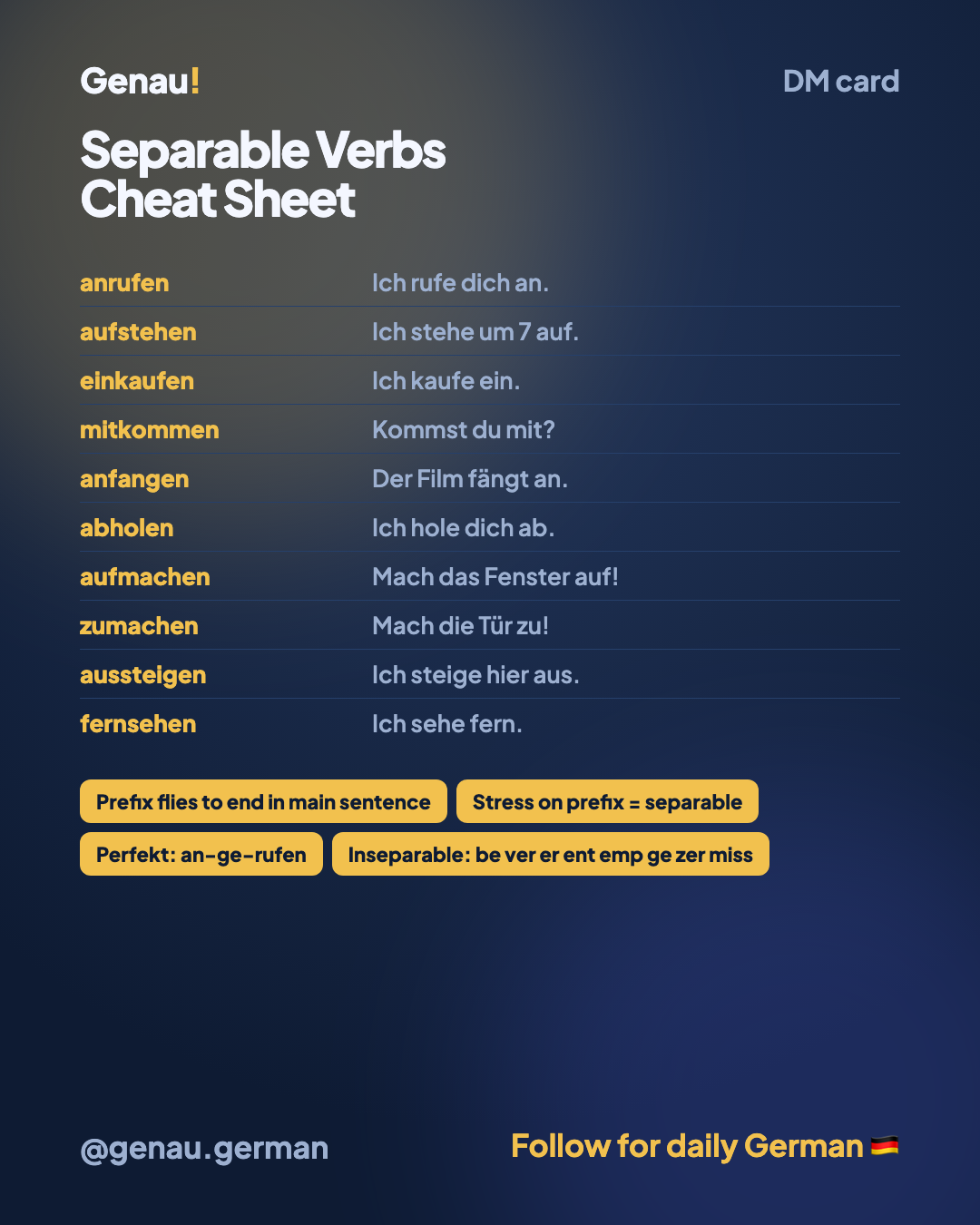
Separable verbs worksheet
The whole topic on one page. Save it to your phone and scan it before the exam.
Related topics
Modal verbs
Ich will Deutsch lernen
Modal verbs express ability, permission or obligation alongside another verb: Ich will Deutsch lernen.
Perfekt
haben or sein?
The spoken past: choosing haben or sein, and building Partizip II.
Modalpartikeln
doch · mal · ja · halt
doch · mal · ja — the small words that stop you sounding like a robot.