Kannst du mal helfen?
Your grammar is fine and Germans still hear a machine. Usually for one reason: your sentences carry no tone. German loads tone into eight tiny words that get dropped into the middle of a sentence — doch · mal · ja · halt · eben · wohl · denn · schon. They have no dictionary meaning, they are never stressed, and every one of them has a twin that means something completely different.
You already do this in English
Nobody ever taught you the difference between Can you help? and Could you just help me a sec? Same request, same grammar. The second one has a word in it — just — that means nothing at all. It carries no information. It only tells the other person how big the favour is.
English is full of them: just · actually · do (do sit down) · then (so where were you then?) · you know · surely · simply. Strip them all out and your English is still grammatically perfect — and you sound like a form letter. That is the exact position most learners are in when they speak German.
Kannst du helfen?
Can you help? — correct German. Also completely flat, and slightly like an order.
Kannst du mal helfen?
Could you just give me a hand? — same sentence, one word, a different human being saying it.
Note the first example is not marked wrong. It is not wrong. Nothing on this page fixes a mistake — it fixes a temperature.
German grammar has a name for these words: Modalpartikeln (also Abtönungspartikeln — «shading particles»). That is the only piece of terminology on this page. What matters is that there are about eight of them, they cover most of everyday speech, and you will hear all eight before lunch.
Every one of them has a twin
Here is why these words feel slippery even at B1: you already know all eight of them — as something else. You learned ja as «yes» in your first week. You learned schon as «already». Then one day a German says Das ist ja teuer! and «yes expensive» makes no sense, so your brain files it under «untranslatable» and moves on.
It is not untranslatable. It is a different word that happens to be spelled the same. Three things separate the particle from its twin: the particle is never stressed, it sits in the middle of the sentence, and you can delete it without breaking the sentence. Its twin fails all three tests.
| Word | As a particle — unstressed, mid-sentence | Its other job — stressed or in its own slot |
|---|---|---|
| ja | Das ist ja teuer! — wow, that is expensive | Ja, gerne. — yes, gladly |
| doch | Komm doch mit! — oh come on, join us | Hast du keinen Hunger? — Doch! — yes I am (contradicting) |
| schon | Das wird schon. — it’ll be fine | Ich bin schon fertig. — I’m already done |
| eben | Das ist eben so. — that’s just how it is | Er ist eben gegangen. — he left just now |
| mal | Warte mal. — hang on a sec | Ich war schon dreimal in Berlin. — three times |
| denn | Was ist denn los? — so what’s going on? | Ich bleibe zu Hause, denn ich bin müde. — because |
| wohl | Er ist wohl krank. — he’s probably ill | Ich fühle mich wohl. — I feel comfortable |
| halt | Das ist halt so. — that’s just how it is | Halt! — stop! (from halten) |
The delete test is the fastest one. Take the word out: if the sentence still stands and only the mood is gone, it was a particle. Das ist teuer. still works. Ich fühle mich. does not.
The eight particles — the table to save
Read the middle column as the feeling, not the meaning. The English on the right is an instinct, not an equation — there is no dictionary entry that maps one to one.
| Particle | The feeling it carries | Lives in | Example | English instinct |
|---|---|---|---|---|
| mal | shrinks the ask — makes a request tiny | requests · imperatives | Kannst du mir mal helfen? | could you just… for a sec |
| mal | vague, unpinned future | statements | Ich rufe dich mal an. | I’ll ring you sometime |
| denn | takes the edge off a question, adds interest | questions only | Was machst du denn? | so what are you up to? |
| denn | surprise, disbelief | questions only | Bist du denn verrückt? | are you out of your mind? |
| doch | warm insistence — pushing, but kindly | imperatives · invitations | Komm doch mit! | oh come on, join us |
| doch | you already know this / I already said this | statements | Das weißt du doch! | but you know that |
| ja | surprise at what is in front of you | statements | Das ist ja teuer! | wow, that is expensive |
| ja | shared knowledge — we both know this | statements | Ich hab’s dir ja gesagt. | I did tell you |
| ja (stressed) | warning, threat | imperatives | Komm ja nicht zu spät! | don’t you dare be late |
| halt | resignation — nothing to be done (south / centre) | statements | Das ist halt so. | that’s just how it is |
| eben | the same resignation (north) | statements | Dann warte ich eben. | fine, I’ll wait then |
| wohl | presumption — I’m guessing, not claiming | statements | Er ist wohl krank. | he’s probably ill / I reckon |
| wohl | indignation, in the pair ja wohl | statements · exclamations | Das ist ja wohl nicht dein Ernst! | you cannot be serious |
| schon | reassurance — it will work out | statements | Du schaffst das schon. | you’ll manage, don’t worry |
| schon | concession — granted, but… | statements | Das ist schon richtig, aber … | true enough, but… |
| eigentlich | by the way / when you think about it | questions · statements | Wie alt bist du eigentlich? | how old are you, actually? |
Do not memorise sixteen rows. Take two: mal and denn. They are the safest, they fit almost any question or request, and they alone will change how people answer you.
Where the particle sits
This is the part that is actually a rule, so it is worth being exact. The particle goes into the middle field of the sentence: after the conjugated verb, after the subject, and after any unstressed pronouns — but before the new information at the end.
| Sentence type | The particle lands… | Example |
|---|---|---|
| Statement | right after the verb | Das ist ja teuer! |
| Statement with pronouns | after the pronouns, not before them | Ich hab’s dir ja gesagt. |
| W-question | after the subject | Was machst du denn? |
| Yes/no question | after subject + pronouns | Kannst du mir mal helfen? |
| Imperative | after the verb and its pronouns | Gib mir mal das Salz. |
| Polite imperative (Sie) | same slot — and it softens the order | Nehmen Sie doch Platz! |
| Subordinate clause | still mid-clause; the verb still goes last | …, weil ich halt müde bin. |
| Separable verb | between the two halves | Ich rufe dich mal an. |
| Perfect tense | before the participle | Das habe ich dir doch gesagt. |
One exception to «never at the front»: eigentlich can open a sentence — Eigentlich wollte ich nicht. The other seven cannot.
Mal kannst du mir helfen?
Wrong. A particle cannot open the sentence. → Kannst du mir mal helfen?
Kannst du mir mal helfen?
Correct. Verb · subject · pronoun · particle · the rest.
«denn» only lives in questions
Every other particle on this page can appear in a statement. denn cannot. As a particle it exists exclusively inside questions — W-questions and yes/no questions alike.
Wo warst du denn so lange?
Where were you all that time then? — worried, curious.
Ich weiß denn nicht.
Wrong. Not a question, so no particle denn. → Ich weiß es halt nicht.
The confusion comes from the twin: denn as a conjunction does live in statements and means «because» — Ich bleibe zu Hause, denn ich bin müde. Different word, same spelling. Tell them apart by the comma: the conjunction always has one in front of it.
A question without denn is not wrong — it just lands harder. Was machst du? can sound like an interrogation. Was machst du denn? sounds like a person.
The part nobody teaches: never stress the particle
Learners who find these words usually make the same mistake next: they are proud of the new word, so they lean on it. And a stressed particle is not a particle any more. The stress belongs on the word after it.
- Say it like this: Das ist ja TEUer! — the weight falls on «teuer».
- Not like this: Das ist JA teuer! — now it sounds like an argument.
- Say it like this: Kannst du mir mal HELfen?
- Not like this: Kannst du mir MAL helfen? — now you are counting occasions.
This is also the fastest way to hear the difference between a particle and its twin in real speech. If a German leans on the word, it is not doing tone work — it is doing meaning work.
«doch» has two lives, and stress decides which one
You met doch at A1 as the answer word: someone asks a negative question, and Doch! means «yes, on the contrary». That one stands alone, at the front, fully stressed.
Hast du keinen Hunger? — Doch!
Aren’t you hungry? — Yes I am. → answer word, stressed, its own slot.
Setz dich doch!
Do sit down. → particle, unstressed, mid-sentence, warm.
And there is a third one in the middle, which is where it gets genuinely interesting: a stressed doch inside a statement means «after all, contrary to what we said».
Ich komme doch mit.
I’m coming along after all. → stress on «doch». Unstressed, the same sentence would just be insistent.
Same four letters, three jobs, and nothing but stress and position to tell them apart. This is why doch is the last particle to click — leave it until mal and denn are automatic.
A stressed «ja» in an imperative is a threat
This one catches people out because it looks harmless on paper. In a command, a stressed ja is not friendly at all — it is the German equivalent of «don’t you dare».
Komm ja nicht zu spät!
Don’t you dare be late. → parent, boss, or someone genuinely annoyed.
Mach das ja nicht!
Don’t you even think about it.
Compare the soft version of the same instruction: Komm doch nicht so spät! — «try not to be so late, would you». One particle apart, two very different relationships.
Practical takeaway: use ja freely in statements (Das ist ja schön!). In imperatives, leave it to native speakers until you can hear the stress yourself.
Particles also travel in pairs, and the order inside a pair is fixed. Do not derive it from a rule — learn the pairs as single chunks:
| Pair | What it does | Example |
|---|---|---|
| doch mal | the everyday favourite — soft nudge | Schau doch mal! — oh go on, have a look |
| mal eben | quickly, in passing | Kannst du mir mal eben helfen? — help me real quick? |
| ja wohl | indignation | Das ist ja wohl nicht dein Ernst! |
| denn eigentlich | curiosity, changing the subject | Was machst du denn eigentlich beruflich? |
| schon noch | reassurance about timing | Er kommt schon noch. — he’ll turn up, don’t worry |
Also worth owning as a chunk: Sag mal, … at the front of a sentence — «tell me / say…», the standard way to open a question you have been sitting on. Sag mal, hast du Zeit?
Where this stops being a rule
Most pages on this topic hand you a table and stop. Here is the honest part, because you will run into all four of these within a month.
- The English column is a hint, not a translation. halt is not «just». There is no English word for it. Anyone who gives you a clean one-to-one list is simplifying.
- halt and eben are regional, and the border is moving. Textbook version: halt in the south and centre, eben in the north. In practice younger speakers use halt everywhere. Both are standard spoken German; neither will ever be misunderstood.
- They stay out of formal writing. No particles in a job application, an essay, or a complaint letter — they read as sloppy there. In a message to a friend, in an email to a colleague you know, and in absolutely all speech: yes.
- One per sentence is normal. Two only in the fixed pairs above. Three and you are doing an impression of a German rather than speaking like one.
And the honest limit on the whole page: not every particle fits every sentence, and no list can tell you which combinations are dead. Was machst du halt? is not a sentence anyone says. When you are unsure, leave the particle out — flat German is never wrong, it is only flat.
One more asymmetry nobody mentions: understanding particles pays off immediately, producing them takes months. You will hear Das ist halt so and know exactly what it means long before you can place halt yourself. That is normal, and it is the right order.
What you just learned
Wo ist ___ die Toilette? (you want it to sound friendly, not like a demand)
Show the answer
denn. It is the question particle — it takes the edge off and adds interest. halt and schon belong in statements; dropped into a question they simply do not work.
Das ist ___ so, da kann man nichts machen.
Show the answer
halt — the resignation particle: nothing to be done. In the north you would hear Das ist eben so. denn is impossible here because this is not a question.
Hast du keinen Hunger? — ___!
Show the answer
Doch! = «yes, on the contrary», the answer to a negative question. Note this is the stressed, standalone doch — a different job from the particle in Komm doch mit!
How to put this in your notebook
The mistake is filing these like vocabulary. A particle has no meaning on its own, so a word list of eight particles is a list of eight blanks. The unit you record is the whole sentence.
- Wrong note: mal = just
- Right note: Kannst du mir mal helfen? — asking a favour · makes it small · stress on helfen
Three columns: the flat sentence · the German version with the particle · the feeling in one word (small · curious · resigned · surprised · reassuring). The third column is the one that makes it stick, because that is what you will actually be searching for when you speak.
- Kannst du helfen? → Kannst du mal helfen? — small
- Was machst du? → Was machst du denn? — curious
- Komm mit! → Komm doch mit! — warm
- Das ist teuer. → Das ist ja teuer! — surprised
- Das ist so. → Das ist halt so. — resigned
- Das wird gut. → Das wird schon. — reassuring
Then pick two for this week — mal and denn — and use nothing else. Two particles used naturally sound better than eight used carefully. Add the next one when the first two stop needing a decision.
A free exercise that costs nothing: in the next German conversation you overhear, count the denns. You will lose count. That is how much tone you have been leaving on the table.
Build the sentence yourself
Tap the words and put them in order. This is the hardest part of German — and there are no options to pick from, you build it.
-
tap the words
-
tap the words
-
tap the words
Know this before the test
The core of the topic in three lines, then the mistakes people make most often.
- Particles tune tone, not facts
mal · denn · doch · ja · halt · wohl change how a sentence FEELS. Grammar survives without them; naturalness doesn't.
Kannst du mir mal helfen?
- mal softens, denn warms questions
Komm mal her = come over, would you · Wo ist denn die Toilette? = friendly, not interrogation.
Was machst du denn?
- doch has three jobs
① Contradict a negative question (Doch!) ② remind (Das weißt du doch) ③ encourage (Komm doch mit!).
Hast du keinen Hunger? — Doch!
- halt and wohl
halt = resigned «that's just how it is» · wohl = «presumably».
Das ist halt so. · Er ist wohl im Urlaub.
Translating mal as «time/once»
mal here is pure softener
Particles carry tone, not dictionary meaning.
Doch. (answering a positive question)
Ja. / Nein.
Doch only pushes back against a negative.
Wo ist die Toilette?! (blunt)
Wo ist denn die Toilette?
Without denn the question can land hard.
Skipping particles entirely
Sprinkle mal/denn/doch where natural
Textbook-perfect German without particles sounds robotic.
Test yourself
Tap an answer — we will look at why together.
Wo ist die Toilette? (you want it to sound friendly, not like a demand)
Das ist so, da kann man nichts machen.
That's just how it is — nothing to be done.
Hast du keinen Hunger? — !
Aren't you hungry? — Yes I am!
Which one is correct German?
Soften a command: Komm her!
Come over here (softly).
Das ist teuer! (surprise: wow, that's expensive)
Wow, that IS expensive!
Practice done — –
To finish the topic, take the full test: score 60% and it is marked as done on your level path.
0/6 · questions answered
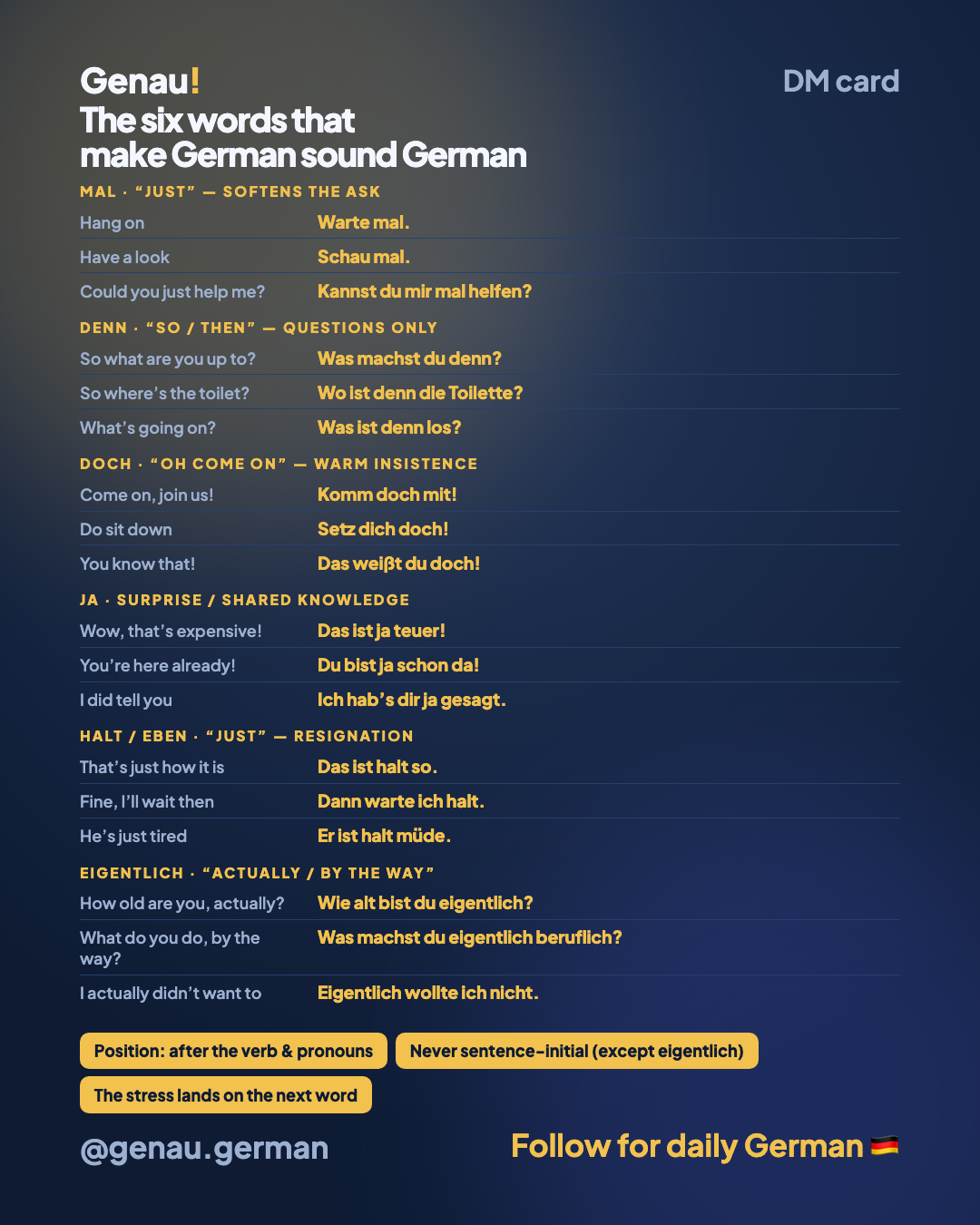
The particle pocket card
The whole topic on one page. Save it to your phone and scan it before the exam.
Related topics
Verb + preposition
Ich warte auf dich
warten auf, denken an — the preposition a verb demands, plus wo(r)-/da(r)-.
nur Bahnhof
saying «I didn’t understand»
What to say the second you stop understanding — the rescue lines and their tone.
Perfekt
haben or sein?
The spoken past: choosing haben or sein, and building Partizip II.