Ich warte für auf dich
If you have said «Ich warte für dich», your German isn’t broken — your translation reflex is. In German the preposition is chosen by the verb, not by the meaning of the sentence. Below: 36 verbs worth memorising, the English-to-German mismatches that cause most of the damage, and the wo(r)- / da(r)- rule almost nobody teaches you properly.
English already does this to you
Why is it wait for and not wait at? Why listen to but think about? There is no reason. Nobody taught you a rule — you memorised the verb and its preposition as one unit, and after a while you stopped noticing there were two words.
German asks for exactly the same thing. Same skill, different pairs. The only extra is that a German preposition also drags a case behind it, so you memorise three things instead of two: verb + preposition + case.
Ich warte auf dich.
I’m waiting for you.
Ich warte für dich.
Word-for-word from English «for». A German hears something closer to «I’m doing your waiting for you».
The whole lesson in one line: never learn the bare verb. Not warten, but warten auf + Akk.
The 36 verbs — this is the table you save
Accusative group first, dative group second. Don’t read it as a list to be swallowed today; read it as a shelf you come back to.
| Verb | Prep. | Case | English | Example |
|---|---|---|---|---|
| warten | auf | Akk | to wait for | Ich warte auf den Bus. |
| denken | an | Akk | to think of, to have in mind | Ich denke an dich. |
| sich freuen | auf | Akk | to look forward to (not yet) | Ich freue mich auf den Urlaub. |
| sich freuen | über | Akk | to be glad about (it happened) | Ich freue mich über dein Geschenk. |
| sich interessieren | für | Akk | to be interested in | Ich interessiere mich für Musik. |
| sich erinnern | an | Akk | to remember | Erinnerst du dich an mich? |
| sich gewöhnen | an | Akk | to get used to | Ich gewöhne mich an das Wetter. |
| glauben | an | Akk | to believe in | Ich glaube an dich. |
| sich kümmern | um | Akk | to look after | Ich kümmere mich um das Kind. |
| bitten | um | Akk | to ask for | Ich bitte um Hilfe. |
| sich bewerben | um | Akk | to apply for (a post) | Ich bewerbe mich um die Stelle. |
| sich ärgern | über | Akk | to be annoyed about | Ich ärgere mich über den Lärm. |
| sprechen | über | Akk | to talk about (topic) | Wir sprechen über das Problem. |
| nachdenken | über | Akk | to think something over | Ich denke über deinen Vorschlag nach. |
| sich beschweren | über | Akk | to complain about | Sie beschwert sich über das Essen. |
| sich vorbereiten | auf | Akk | to prepare for | Ich bereite mich auf die Prüfung vor. |
| sich konzentrieren | auf | Akk | to concentrate on | Ich konzentriere mich auf die Arbeit. |
| sich verlassen | auf | Akk | to rely on | Ich verlasse mich auf dich. |
| hoffen | auf | Akk | to hope for | Wir hoffen auf besseres Wetter. |
| achten | auf | Akk | to pay attention to | Achte auf den Verkehr. |
| verzichten | auf | Akk | to do without, to give up | Ich verzichte auf Zucker. |
| sorgen | für | Akk | to provide for | Er sorgt für seine Familie. |
| sich entscheiden | für | Akk | to decide on | Ich entscheide mich für den blauen Mantel. |
| sich verlieben | in | Akk | to fall in love with | Er hat sich in sie verliebt. |
| Angst haben | vor | Dat | to be afraid of | Ich habe Angst vor dem Hund. |
| warnen | vor | Dat | to warn about | Ich warne dich vor ihm. |
| fragen | nach | Dat | to ask about | Er fragt nach dem Weg. |
| suchen | nach | Dat | to search for | Sie sucht nach ihrem Schlüssel. |
| sprechen | mit | Dat | to talk to (person) | Ich spreche mit dem Arzt. |
| anfangen | mit | Dat | to start with | Wir fangen mit der Arbeit an. |
| aufhören | mit | Dat | to stop doing | Ich höre mit dem Rauchen auf. |
| sich beschäftigen | mit | Dat | to occupy oneself with | Ich beschäftige mich mit Geschichte. |
| teilnehmen | an | Dat | to take part in | Ich nehme an dem Kurs teil. |
| arbeiten | an | Dat | to work on | Ich arbeite an einem Projekt. |
| zweifeln | an | Dat | to doubt | Ich zweifle an seiner Ehrlichkeit. |
| träumen | von | Dat | to dream of | Ich träume von einem Haus. |
| abhängen | von | Dat | to depend on | Das hängt vom Wetter ab. |
| gehören | zu | Dat | to be part of | Das gehört zu meinem Job. |
| einladen | zu | Dat | to invite to | Ich lade dich zu meiner Party ein. |
| gratulieren | zu | Dat | to congratulate on | Ich gratuliere dir zum Geburtstag. |
| sich bedanken | bei | Dat | to thank someone | Ich bedanke mich bei dir. |
| bestehen | aus | Dat | to consist of | Das Buch besteht aus drei Teilen. |
| leiden | unter | Dat | to suffer from (conditions) | Sie leidet unter dem Lärm. |
Don’t try to memorise the whole thing in one sitting — it settles by use, not by staring. Today’s only job: pick the five verbs that actually show up in your own speech and write them down with their preposition.
A few of these carry two prepositions at once, one for the person and one for the thing: sich bedanken bei jemandem für etwas, sich beschweren bei jemandem über etwas, sich entschuldigen bei jemandem für etwas. Same shape every time: bei for the human, something else for the matter.
The preposition is not a translation
auf normally means «on top of». In warten auf it points to no surface at all. an normally means «at, on the side of». In denken an nothing is leaning on anything. So stop trying to reason your way to the right preposition — there is nothing left to reason with.
The real danger isn’t that German is illogical. It’s that English is also illogical here, and you carry your own pairs across without noticing. This table is where most B1 mistakes actually live.
| English | What you say by reflex | Correct German | Case |
|---|---|---|---|
| wait for | warten für | warten auf | Akk |
| think about someone | denken über | denken an | Akk |
| be interested in | sich interessieren in | sich interessieren für | Akk |
| be afraid of | Angst haben von | Angst haben vor | Dat |
| ask for | bitten für | bitten um | Akk |
| apply for | sich bewerben für | sich bewerben um | Akk |
| depend on | abhängen auf | abhängen von | Dat |
| believe in | glauben in | glauben an | Akk |
| take part in | teilnehmen in | teilnehmen an | Dat |
| congratulate on | gratulieren auf | gratulieren zu | Dat |
| consist of | bestehen von | bestehen aus | Dat |
| protect from | schützen von | schützen vor | Dat |
| remind of | erinnern von | erinnern an | Akk |
| look forward to | sich freuen zu | sich freuen auf | Akk |
| talk to someone | sprechen zu | sprechen mit | Dat |
One caveat on the last row: sprechen zu does exist, but it means speaking at an audience from a podium — Der Präsident spricht zu dem Volk. For an ordinary conversation it is always mit.
And the mismatch runs the other way too. Some English verbs that need a preposition take none at all in German — just a bare case. These are the ones that make learners insert a preposition that shouldn’t be there.
- listen to music → Musik hören (bare accusative, no preposition)
- listen to someone → jemandem zuhören (bare dative) — Ich höre dir zu.
- help someone → jemandem helfen (dative) — Ich helfe dir.
- answer someone → jemandem antworten (dative), but answer a question → auf eine Frage antworten
- call someone → jemanden anrufen (accusative) — Ich rufe dich an.
- marry someone → jemanden heiraten (accusative) — Sie hat ihn geheiratet.
- follow someone → jemandem folgen (dative) — Folge mir.
So if you keep getting the preposition wrong, the problem isn’t your memory — it’s how you filed the word. Fix the filing and the recall fixes itself.
Two named traps
Same verb, two prepositions, two timeframes
Ich freue mich auf das Wochenende.
I’m looking forward to the weekend. → it HASN’T happened yet
Ich freue mich über dein Geschenk.
I’m glad about your present. → it HAS happened
The preposition here isn’t carrying meaning, it’s carrying time. auf looks forward, über looks at something that already landed. German has no separate tense for this — the preposition does the job.
The same split shows up elsewhere: sich ärgern über is always about something that happened, while hoffen auf and warten auf are always pointed at the future. Once you see it as a time arrow, you stop guessing.
Person or topic?
Ich spreche mit ihm über dich.
I’m talking to him about you.
mit + dative = the person you talk to. über + accusative = the subject you talk about. Both sit in the same sentence without interfering.
Ich spreche über ihm.
Two errors at once: über takes accusative, and «über + person» means gossiping about him, not speaking with him.
Same pattern, other verbs: sich bedanken bei jemandem für etwas · sich beschweren bei jemandem über etwas · sich entschuldigen bei jemandem für etwas. The human always gets bei + dative.
Ich beschwere mich beim Kellner über das Essen.
I’m complaining to the waiter about the food.
Forget the A1 wo/wohin rule here
At A1 you learned it: with an · auf · über · in · vor · unter, ask wo? for dative and wohin? for accusative. In verb prepositions that rule does nothing, because the preposition isn’t describing a location any more. The case is welded to the verb and you can’t derive it from a question.
| Preposition | Case as a verb preposition | Example |
|---|---|---|
| auf | accusative, in almost every verb | warten auf den Bus |
| über | always accusative | sprechen über das Problem |
| für · um · gegen · ohne | always accusative | sich bewerben um die Stelle |
| in | accusative with verbs of turning into / falling into | sich verlieben in dich |
| mit · von · zu · bei · nach · aus | always dative | träumen von einem Haus |
| vor | dative as a verb preposition | Angst haben vor dem Hund |
| unter | dative as a verb preposition | leiden unter dem Lärm |
| an | SPLITS IN TWO — see below | denken an dich · teilnehmen an dem Kurs |
The honest exception to row one: bestehen auf («to insist on») takes the dative — Ich bestehe auf meinem Recht. It is the one auf verb at this level that breaks the pattern.
«an» splits by verb
an + accusative: denken an · sich erinnern an · sich gewöhnen an · glauben an · sich wenden an — all of them are turning towards something in your head.
an + dative: teilnehmen an · arbeiten an · leiden an · zweifeln an · erkranken an — all of them are already inside the thing.
Ich denke an den Kurs.
I’m thinking about the course. → accusative, I turn towards it
Ich nehme an dem Kurs teil.
I’m taking part in the course. → dative, I’m already in it
This is a working memory hook, not a law — it holds for the common verbs and it will not save you on every one. When you’re unsure, look it up: a decent dictionary prints the case right next to the verb.
The part nobody teaches: wo(r)- / da(r)-
Here is where B1 speakers give themselves away. When the thing after the preposition is not a person — an object, an idea, a situation — you cannot say auf was or auf es. German fuses the preposition into one word instead.
Worauf wartest du?
What are you waiting for? → question: wo(r)- + preposition
Ich warte darauf.
I’m waiting for it. → answer: da(r)- + preposition
If the preposition starts with a vowel, an -r- slides in to keep it pronounceable: worauf · daran · worüber. If it starts with a consonant, nothing is added: womit · davon · dafür.
| Preposition | Question | Pointer | Example |
|---|---|---|---|
| auf | worauf | darauf | Worauf wartest du? — Darauf. |
| an | woran | daran | Woran denkst du? |
| über | worüber | darüber | Worüber ärgerst du dich? |
| für | wofür | dafür | Wofür interessierst du dich? |
| um | worum | darum | Worum geht es? |
| in | worin | darin | Worin besteht der Unterschied? |
| mit | womit | damit | Womit fängst du an? |
| von | wovon | davon | Wovon träumst du? |
| zu | wozu | dazu | Wozu gehört das? |
| nach | wonach | danach | Wonach suchst du? |
| vor | wovor | davor | Wovor hast du Angst? |
| unter | worunter | darunter | Worunter leidest du? |
| aus | woraus | daraus | Woraus besteht das? |
| bei | wobei | dabei | Wobei kann ich dir helfen? |
Several of these forms have a second life as connectors: damit also means «so that», darum «that’s why», danach «afterwards», dabei «at the same time». Only the sentence tells you which one you’re looking at — if a subordinate clause with the verb at the end follows, it’s the connector.
With people the rule switches off
Auf wen wartest du? — Auf ihn.
Who are you waiting for? — For him. → PERSON: normal pronoun
An wen denkst du? — An sie.
Who are you thinking of? — Of her.
Worauf wartest du? (meaning a person)
Wrong — worauf/darauf are only for things and situations.
Ich warte auf es.
Wrong the other way — for a thing it has to be «darauf».
One line to keep: thing → darauf, human → auf ihn. The day you get this distinction right by reflex is the day your German starts sounding B1 rather than translated.
Animals sit in between. Usage genuinely wavers: a stray dog tends to get davor, the family dog often gets vor ihm. Nobody will correct you either way.
One more use, and it’s the one that makes long sentences possible: da(r)- can be the hook that a following clause hangs on. Ich warte darauf, dass du anrufst. («I’m waiting for you to call.») Drop the darauf there and the sentence stops being German.
Honest footnote: this hook is compulsory with some verbs (warten auf, sich gewöhnen an) and optional with others — Ich freue mich, dich zu sehen. is perfectly correct without it. Don’t force it in everywhere.
And what you will actually hear on the street: Auf was wartest du? is extremely common in spoken German, and northern speakers split the form in two — Da warte ich schon lange drauf. Both are real; neither belongs in a written exam.
What you just learned
Ich warte ___ dich.
Show the answer
auf. warten auf + Akkusativ. «für» is the straight translation of English «for» — with this verb German doesn’t accept it.
Ich freue mich ___ deinen Brief. (the letter has arrived)
Show the answer
über — the event already happened. For something still ahead of you it’s auf: Ich freue mich auf den Urlaub.
___ wartest du? (you mean your brother)
Show the answer
Auf wen. The wo(r)-/da(r)- forms are only for things and situations, so Worauf would mean you’re waiting for an object. «Auf was» is heard in speech but is not standard written German — for a thing the correct written form is Worauf.
Change how you take notes
This topic is not fixed by studying harder. It is fixed by changing the unit you record. As long as the bare verb sits alone in your notebook, you will run the calculation again in the middle of every sentence.
- ✗ warten = to wait
- ✓ warten auf + Akk = to wait for — Ich warte auf den Bus.
Three boxes per entry: verb + preposition + case, and next to them one example sentence from your own life. Somebody else’s sentence evaporates. Yours stays.
- Write the pair, never the verb alone.
- Add the case in shorthand: + Akk or + Dat.
- Write one sentence you would genuinely say this week.
- For anything mental (thinking, remembering, waiting, hoping), also write the da(r)- form: darauf · daran · darüber.
Five verbs a week is enough. That’s 60 in three months — which is, more or less, the entire verb-plus-preposition load of a B1 exam.
Build the sentence yourself
Tap the words and put them in order. This is the hardest part of German — and there are no options to pick from, you build it.
-
tap the words
-
tap the words
-
tap the words
Know this before the test
The core of the topic in three lines, then the mistakes people make most often.
- Learn verb and preposition as one word
warten auf · sich interessieren für · denken an · sich ärgern über — the preposition is part of the verb, not a choice.
Ich warte auf dich.
- auf = ahead, über = behind you
sich freuen auf = look forward to (future) · sich freuen über = be happy about (it happened).
auf das Wochenende · über deinen Brief
- Things ask with wo(r)-
Worauf wartest du? (thing) vs Auf wen wartest du? (person).
Worauf wartest du?
- Things compress to da(r)-
Ich warte darauf. · Ich denke daran. People keep the pronoun: auf ihn · an sie.
Ich warte darauf.
Ich warte für dich.
Ich warte auf dich.
The English «wait for» leaks in; German fixes auf.
Ich freue mich auf deinen Brief. (letter already here)
Ich freue mich über deinen Brief.
Arrived things take über.
Auf was wartest du?
Worauf wartest du?
Standard German asks things with wo(r)-.
Ich warte auf es.
Ich warte darauf.
Things compress to da(r)+preposition.
Test yourself
Tap an answer — we will look at why together.
Ich warte dich.
I am waiting for you.
Ich freue mich deinen Brief. (the letter has arrived)
Ich nehme dem Kurs teil.
I am taking part in the course.
wartest du? (you mean your brother)
Ich freue mich das Wochenende. (looking forward)
I'm looking forward to the weekend.
Ich interessiere mich Geschichte.
I am interested in history.
Practice done — –
To finish the topic, take the full test: score 60% and it is marked as done on your level path.
0/6 · questions answered
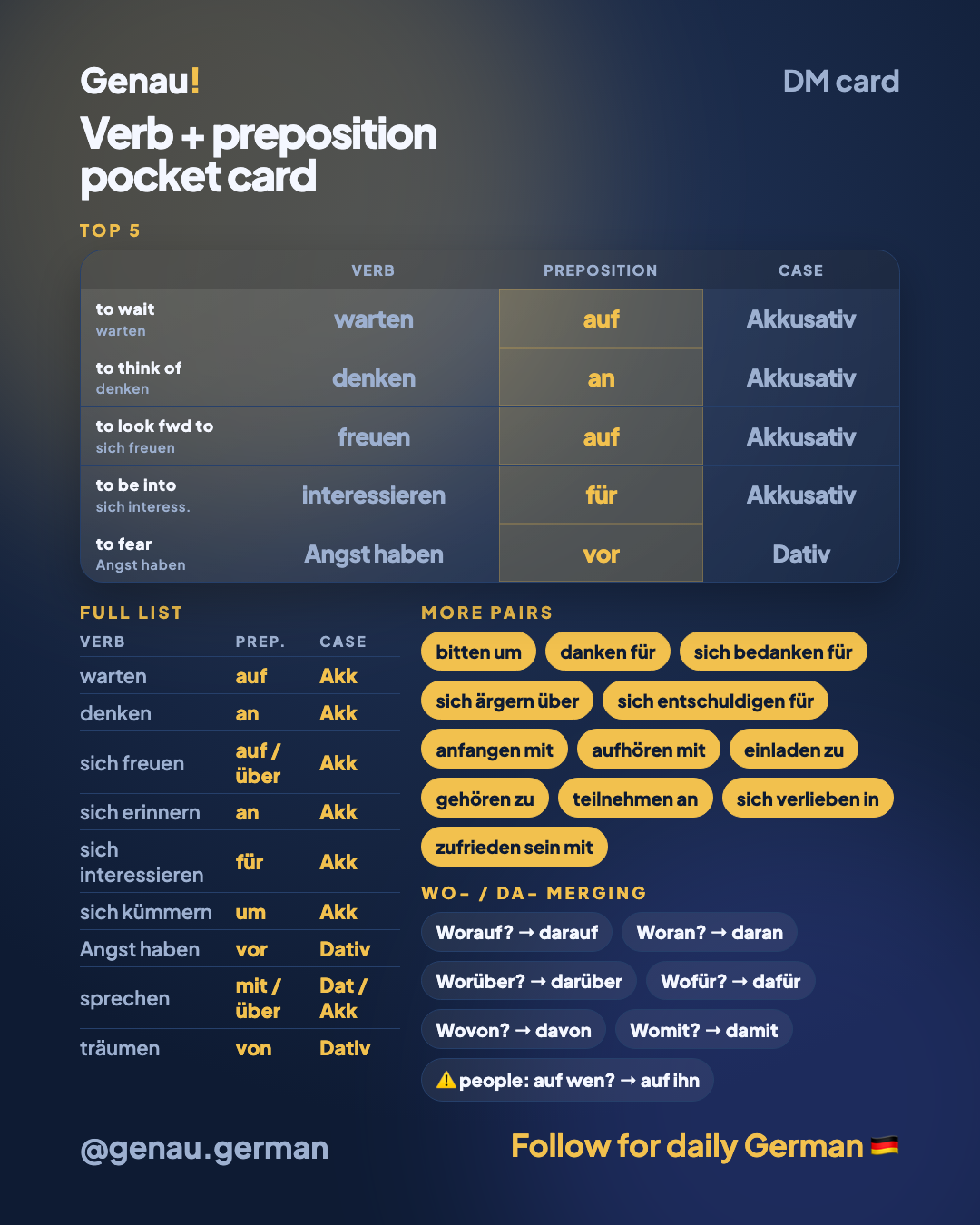
Verb + preposition pocket card
The whole topic on one page. Save it to your phone and scan it before the exam.
Related topics
Pronouns
mich or mir?
mich or mir — the full pronoun table and which case turns up when.
Akkusativ & Dativ
the full article table
Accusative vs dative: what actually changes, and what never moves at all.
Perfekt
haben or sein?
The spoken past: choosing haben or sein, and building Partizip II.