Ich helfe dich dir
English has one object form: him. German has two — ihn and ihm — and the verb decides which one you get. Below: the full 13-row table, the ihr trap that catches everyone, the verbs that ignore English intuition, and the word-order rule almost no A1 book prints.
English already does half of this
You say I see him, never I see he. You say I gave him the book, never I gave he the book. Nobody taught you a rule there — you learnt he / him, she / her, they / them as a pair and stopped thinking about it.
That is a case system. English kept it, but only on pronouns, and only in a shrunken form: it merged the two object cases into one word. German never merged them. So the single English word him arrives in German as two different words, and which one you need depends on the verb in front of it.
Ich sehe ihn.
I see him. → he is the thing being seen (Akkusativ)
Ich gebe ihm das Buch.
I give him the book. → the book goes to him (Dativ)
Same for her: Ich sehe sie (I see her) but Ich helfe ihr (I help her). One English word, two German ones. This is the whole topic — everything below is just the list.
And you still have one surviving trace of the third case: who / whom. German runs that same split every day, out loud, with no hesitation: wer · wen · wem.
So the mental move is not «learn a foreign concept». It is: take the object form you already have and split it in two. Direct object → Akkusativ. Something given, said, shown or done to someone → Dativ.
The table — this is the part you save
Nine rows cover every person. The four rows after that are the ones the carousel had no room for — question words and indefinites — and they inflect exactly the same way, so you get them almost for free.
| Person | Nominativ | Akkusativ | Dativ | English object |
|---|---|---|---|---|
| 1st sg. | ich | mich | mir | me |
| 2nd sg. — informal | du | dich | dir | you |
| 3rd sg. masc. | er | ihn | ihm | him — or it |
| 3rd sg. fem. | sie | sie | ihr | her — or it |
| 3rd sg. neut. | es | es | ihm | it |
| 1st pl. | wir | uns | uns | us |
| 2nd pl. — informal | ihr | euch | euch | you (all) |
| 3rd pl. | sie | sie | ihnen | them |
| polite — sg. + pl. | Sie | Sie | Ihnen | you (formal) |
| question word | wer | wen | wem | who / whom |
| impersonal | man | einen | einem | one / you in general |
| somebody | jemand | jemanden | jemandem | somebody |
| nobody | niemand | niemanden | niemandem | nobody |
Do not read this table row by row. Read it by what does not move — that is three quarters of the work done in one look.
- sie and es never change in the accusative. Ich sehe sie. · Ich sehe es. Exactly like the articles die and das. Same logic, same rows.
- uns and euch are identical in both cases. One form, two jobs. Two full rows of the table cost you nothing.
- Only er actually has three distinct forms: er · ihn · ihm. If you can say those three in your sleep, the masculine is finished.
- The polite Sie is capitalised in every case: Sie · Sie · Ihnen. If it is capitalised mid-sentence, it is talking to a person you address formally.
- Dativ is where the endings live: mir · dir · ihm · ihr · uns · euch · ihnen. Say that line out loud a few times — it is the single most useful sequence on this page.
Genitive pronouns (meiner, seiner) exist and you can ignore them at A2. They appear in a handful of fixed expressions and in literature, almost never in speech.
Three words that look identical and are not
The table itself is short. What actually costs learners points is that German recycles the same three or four letters for completely different jobs. Here are the collisions, named, so you recognise them the moment they appear.
ihr — four jobs, one spelling
Ihr kommt zu spät.
You (all) are late. → subject, 2nd person plural
Ich helfe ihr.
I am helping her. → dative of sie (she)
Das ist ihr Bruder.
That is her brother. → possessive
Das ist ihr Haus.
That is their house. → possessive again, but plural owners
Four jobs, zero difference in spelling. The good news: they never compete for the same slot. In front of a noun it is possessive. Standing alone as a subject it is «you all». Standing alone after a dative verb it is «to her».
The sentence that catches everybody: Ich helfe ihr. Learners read the ihr they met first — «you all» — and hear «I help you». It says her. «I help you all» is Ich helfe euch.
Ihnen or ihnen — one capital letter, opposite meaning
Ich danke Ihnen.
Thank you. → to one or more people you address formally
Ich danke ihnen.
I thank them. → to a group of other people
In writing the capital is the entire difference, and getting it wrong in an email reads as either cold or oddly familiar. In speech there is no difference at all — the two are pronounced identically and context does the whole job. That is not a flaw you can fix; native speakers rely on context too.
Same collision one row up: sie can be «she» or «they», Sie is «you (formal)». The verb ending separates two of them — sie kommt = she comes, sie kommen = they come. But Sie kommen and sie kommen sound the same, and again only context decides.
ihm is not always «him»
Das Kind weint. Ich helfe ihm.
The child is crying. I am helping it/them. → das Kind is neuter, so its dative is ihm
Both er and es land on the same dative form, ihm. So ihm can mean «to him» or «to it» — and, as above, «to that child». The word tells you the case, not the sex of anybody.
This runs the other way too, and it is the mistake English speakers make most: objects are not «it» in German. A pronoun copies the grammatical gender of its noun.
Ich habe einen Tisch gekauft. Er war nicht teuer.
I bought a table. It was not expensive. → der Tisch → er, never es
Wo ist die Brille? — Sie liegt auf dem Tisch.
Where are the glasses? — They are on the table. → die Brille → sie
Hast du den Schlüssel? — Ja, ich habe ihn.
Do you have the key? — Yes, I have it. → ihn here means «it», not «him»
Which means: every time you say es for a random object, you are guessing wrong two times out of three. The pronoun is only as good as the article you learnt with the noun.
The verb decides — and it does not consult English
Most of the time your instinct works. I see you → direct object → Ich sehe dich. The problem is a short, extremely common list of verbs where German chose the dative and English chose a plain object. There is no logic to reverse-engineer here. There is a list.
| Verb | Meaning | Case | Example |
|---|---|---|---|
| helfen | to help | Dativ | Kannst du mir helfen? |
| danken | to thank | Dativ | Ich danke dir. |
| folgen | to follow | Dativ | Folge mir. |
| antworten | to answer (a person) | Dativ | Ich antworte dir morgen. |
| glauben | to believe (a person) | Dativ | Ich glaube ihm nicht. |
| vertrauen | to trust | Dativ | Ich vertraue ihr. |
| gratulieren | to congratulate | Dativ | Ich gratuliere dir zum Geburtstag. |
| zuhören | to listen to | Dativ | Hör mir zu. |
| gehören | to belong to | Dativ | Der Mantel gehört ihr. |
| gefallen | to please / to like | Dativ | Das Lied gefällt mir. |
| schmecken | to taste good to | Dativ | Das Essen schmeckt uns. |
| passen | to fit / to suit | Dativ | Die Jacke passt dir gut. |
| fehlen | to be missed by | Dativ | Du fehlst mir. |
| wehtun | to hurt | Dativ | Der Rücken tut mir weh. |
| verzeihen | to forgive | Dativ | Ich verzeihe dir. |
| ähneln | to resemble | Dativ | Sie ähnelt ihrer Mutter. |
| begegnen | to run into | Dativ | Ich bin ihm gestern begegnet. |
| schaden | to harm | Dativ | Rauchen schadet dir. |
Four of these — gefallen · schmecken · fehlen · wehtun — also flip the sentence around. The thing is the subject, you are the dative object. Du fehlst mir is literally «you are missing to me», which is why «I miss you» comes out backwards so often.
Now the mirror image. These feel like they should take the dative in English — ask someone, call someone, support someone — but German treats the person as a plain direct object.
Ich frage dich.
I am asking you. → Akkusativ, not dir
Ich rufe dich später an.
I will call you later. → anrufen + Akkusativ
Ich unterstütze dir dich.
I support you — unterstützen takes the accusative, even though «help» next to it takes the dative.
Same group: treffen (to meet), verstehen (to understand), brauchen (to need), bitten (to ask a favour of), erreichen (to reach). All accusative. Ich verstehe euch nicht. · Sie braucht uns.
And the third group, the easy one: verbs of giving take both. The person is dative, the thing is accusative — geben · schenken · zeigen · erklären · schicken · bringen · erzählen · empfehlen · leihen.
Ich schenke dir eine Uhr.
I am giving you a watch. → dir = person (Dativ), eine Uhr = thing (Akkusativ)
Sie erklärt uns die Regel.
She is explaining the rule to us.
Honest version of the rule: there is no test that predicts the dative verbs. Duden lists the case next to the verb; that is where the information actually lives. Everything above is a list to be met often, not a system to be derived.
After a preposition, the preposition decides
If a preposition comes first, the verb stops having an opinion. für always takes the accusative — no matter what the sentence is doing. So the pronoun table you just learnt gets re-used, driven by a different switch.
| Preposition | Case | With a pronoun | Example |
|---|---|---|---|
| für | Akkusativ | für mich | Ich mache das für dich. |
| ohne | Akkusativ | ohne dich | Ohne dich gehe ich nicht. |
| gegen | Akkusativ | gegen ihn | Er ist gegen mich. |
| um | Akkusativ | um uns | Er kümmert sich um uns. |
| durch | Akkusativ | durch sie | Ich habe es durch sie erfahren. |
| mit | Dativ | mit mir | Kommst du mit mir? |
| von | Dativ | von dir | Das ist ein Geschenk von ihr. |
| bei | Dativ | bei ihm | Ich wohne bei ihnen. |
| zu | Dativ | zu ihr | Ich gehe zu ihm. |
| nach | Dativ | nach uns | Du kommst nach mir dran. |
| außer | Dativ | außer mir | Alle außer mir waren da. |
| gegenüber | Dativ | mir gegenüber | Sie sitzt mir gegenüber. |
With gegenüber the pronoun normally goes in front of the preposition. It is the one entry on this list you should learn as a fixed phrase.
For things, German does not use a pronoun at all
This is the rule that makes learner German sound instantly foreign. If what follows the preposition is a thing and not a person, the pronoun is not used — the preposition fuses with da- instead.
Ich warte auf meinen Bruder. → Ich warte auf ihn.
A person: preposition plus normal pronoun.
Ich warte auf den Bus. → Ich warte darauf.
A thing: auf + es is impossible — it becomes darauf.
Ich warte auf es.
Never said. This form simply does not exist in German.
The question word does the same thing with wo-: Womit schreibst du? (with what) versus Mit wem sprichst du? (with whom). An -r- slides in whenever the preposition starts with a vowel: worauf · darauf · worüber · darüber.
| Preposition | Thing (statement) | Thing (question) | Person |
|---|---|---|---|
| mit | damit | womit | mit ihm / mit wem |
| für | dafür | wofür | für ihn / für wen |
| von | davon | wovon | von ihm / von wem |
| auf | darauf | worauf | auf ihn / auf wen |
| an | daran | woran | an ihn / an wen |
| über | darüber | worüber | über ihn / über wen |
| zu | dazu | wozu | zu ihm / zu wem |
| nach | danach | wonach | nach ihm / nach wem |
| bei | dabei | wobei | bei ihm / bei wem |
| gegen | dagegen | wogegen | gegen ihn / gegen wen |
The rule has a gap, and you should know it: ohne and außer build no da- form. For those you fall back on a demonstrative — Ich kann nicht ohne das leben. You will also hear speakers say mit dem instead of damit when they are pointing at something. That is normal spoken German; the da- form is what you write.
The part nobody teaches: which pronoun goes first
Here is the section most A1 books leave out entirely. You can know every cell of the table and still build the sentence in the wrong order — and this is the mistake that marks a sentence as learner German faster than a wrong case does.
| What you have | Order | Example |
|---|---|---|
| two nouns | Dativ first | Ich gebe dem Mann das Buch. |
| one pronoun, one noun | the pronoun moves up front | Ich gebe es dem Mann. · Ich gebe ihm das Buch. |
| two pronouns | Akkusativ first — the order flips | Ich gebe es ihm. |
One line to remember it by: the lighter word goes first. Pronouns outrank nouns, and among two pronouns the accusative outranks the dative.
Ich gebe ihm es
Ich gebe ihm es.
The single most common learner sentence in this topic. Native speakers do not say it.
Ich gebe es ihm.
I give it to him. → two pronouns, accusative first.
Why does it happen? Because with nouns the dative genuinely does come first — Ich gebe dem Mann das Buch — and you carry that order over. The moment both objects become pronouns, German reverses it.
And you already do the same thing in English, which is why this is easier than it looks. I gave him the book is fine. I gave him it is not — you say I gave it to him. English reorders too when both objects shrink to pronouns. German just does it without adding to.
The rule survives every sentence shape, because the pronouns simply sit at the front of the middle field and the verb parts move around them:
Ich habe es ihm gegeben.
I gave it to him. → perfect tense
Morgen gebe ich es ihm.
I will give it to him tomorrow. → after inversion
Ich kann es dir erklären.
I can explain it to you. → with a modal verb
Er sagt, dass er es uns schickt.
He says he is sending it to us. → subordinate clause
Zeig es mir.
Show it to me. → imperative
One step further, and this is genuinely B1 territory: an object pronoun can jump in front of a noun subject. Gestern hat mir mein Vater das Auto geliehen. The version with the subject first — Gestern hat mein Vater mir das Auto geliehen — is also correct. Both are said; the pronoun-early one is the one you hear more.
What this page does not cover: reflexive pronouns. Ich wasche mich versus Ich wasche mir die Hände runs on the same accusative/dative split but has its own logic, and it deserves its own page rather than three lines here.
What you just learned
Kannst du ___ helfen?
Show the answer
mir. helfen takes the dative, although «help me» feels like a plain object in English. Same group: danken · folgen · antworten · vertrauen. Learn the case together with the verb, not separately.
Giving the book to him, both as pronouns: Ich gebe ___ .
Show the answer
es ihm. With two nouns the dative comes first (Ich gebe dem Mann das Buch), but with two pronouns the order flips and the accusative leads. ihn is wrong as well — das Buch is neuter, so its accusative is es.
Ich warte auf den Zug. → Ich warte ___ .
Show the answer
darauf. The train is a thing, so the preposition fuses with da- and the pronoun disappears. auf es does not exist in German at all. auf ihn would be right only for a person: Ich warte auf meinen Bruder → auf ihn.
How to put this in your notebook
This topic does not get solved by studying the table longer. It gets solved by changing how you record verbs — because the pronoun is never the problem, the verb in front of it is.
- ❌ helfen = to help
- ✅ helfen + Dativ = to help — Kannst du mir helfen?
- ❌ warten auf = to wait for
- ✅ warten auf + Akk — person: auf ihn · thing: darauf
Three boxes per entry: the verb · the case it forces · one sentence about someone you actually know. A textbook sentence disappears in a week. A sentence about your own brother does not.
- Say the dative line out loud until it is one word: mir · dir · ihm · ihr · uns · euch · ihnen. Thirty seconds a day, one week.
- Take the eighteen dative verbs above and write one true sentence for each. True, not correct — the sentence has to be about your real life.
- Once a week, take five sentences you already wrote and replace every noun with a pronoun. This is where dem Mann → ihm and das Buch → es stop needing thought.
- Then do it twice: replace both objects and check the order. Ich gebe dem Mann das Buch → Ich gebe es ihm. That single drill is the whole word-order section.
- Whenever you hesitate mid-sentence, write down which verb caused it. That verb is tomorrow’s list.
Realistic pace: the table is one afternoon, the traps are one week, the dative verbs are about six weeks of noticing them in the wild. The word-order rule is the fastest of all — most people fix it permanently after being corrected once.
Build the sentence yourself
Tap the words and put them in order. This is the hardest part of German — and there are no options to pick from, you build it.
-
tap the words
-
tap the words
-
tap the words
Know this before the test
The core of the topic in three lines, then the mistakes people make most often.
- Three columns per person
ich → mich → mir · du → dich → dir · er → ihn → ihm. The verb decides the column.
Ich frage dich. · Ich helfe dir.
- Objects keep their gender
der Schlüssel → er/ihn · die Lampe → sie. Calling everything es is the classic error.
Ich sehe ihn nicht.
- Two pronouns: accusative first
Ich gebe es ihm. · Ich zeige es dir. With two nouns the order is reversed.
Ich gebe es ihm.
- Things with prepositions → da-
Ich warte darauf, not auf es. People keep the real pronoun.
Ich warte darauf.
Ich helfe dich.
Ich helfe dir.
helfen forces the dative column.
Der Schlüssel? Ich sehe es nicht.
Ich sehe ihn nicht.
Masculine object → ihn.
Ich gebe ihm es.
Ich gebe es ihm.
Accusative pronoun first.
Ich rufe dir an.
Ich rufe dich an.
anrufen takes accusative — English «call to» misleads.
Test yourself
Tap an answer — we will look at why together.
Kannst du helfen?
Can you help me?
Giving the book to him, both as pronouns: Ich gebe .
«Ich danke ihr.» — who are you thanking?
Ich warte auf den Zug. → Ich warte .
I am waiting for it.
Wo ist der Schlüssel? — Ich sehe nicht.
Where's the key? — I can't see it.
Wie geht es ? (asking your boss, politely)
Practice done — –
To finish the topic, take the full test: score 60% and it is marked as done on your level path.
0/6 · questions answered
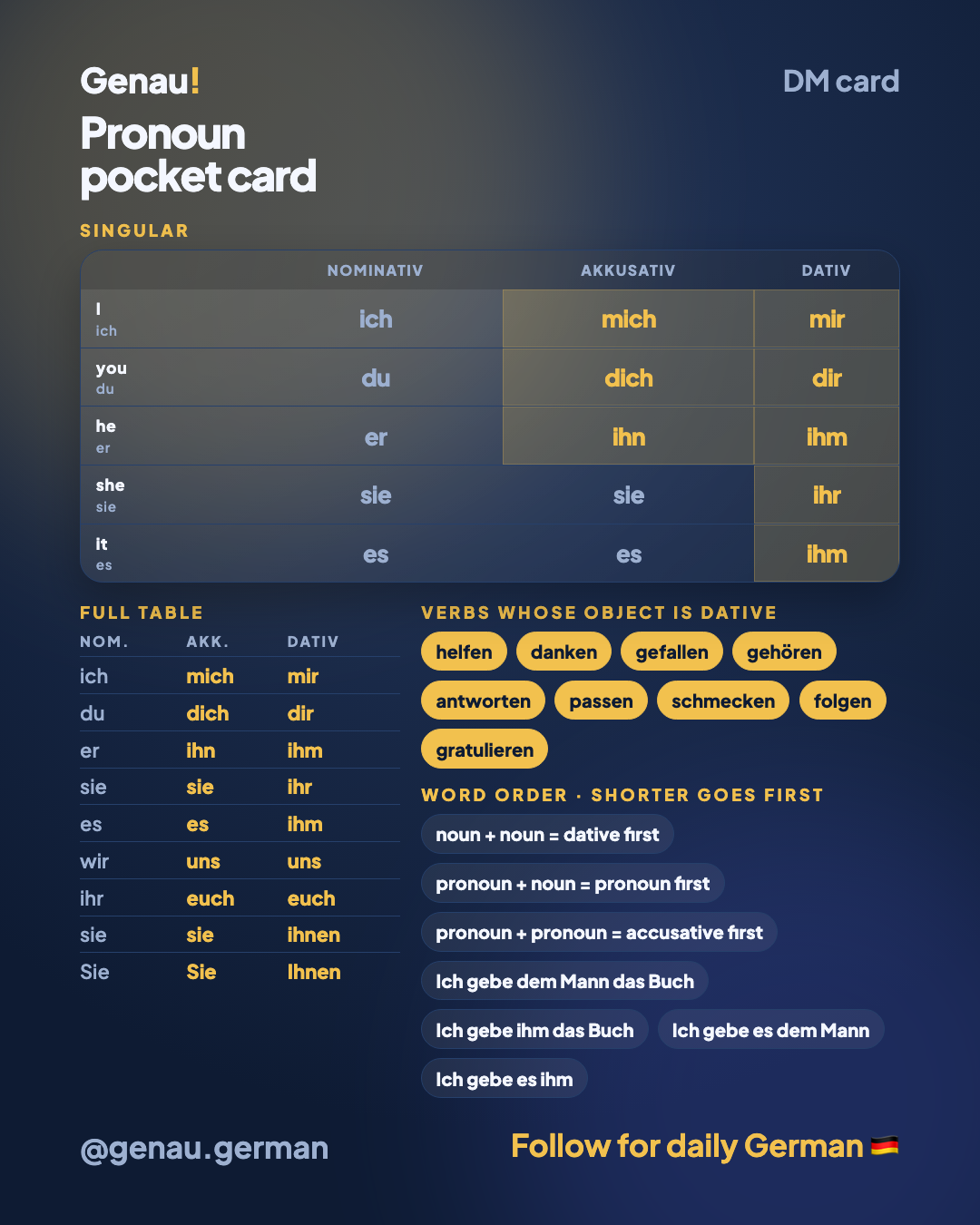
Pronoun pocket card
The whole topic on one page. Save it to your phone and scan it before the exam.
Related topics
Akkusativ & Dativ
the full article table
Accusative vs dative: what actually changes, and what never moves at all.
Perfekt
haben or sein?
The spoken past: choosing haben or sein, and building Partizip II.
Verb + preposition
Ich warte auf dich
warten auf, denken an — the preposition a verb demands, plus wo(r)-/da(r)-.