Ich helfe den dem Mann
English marks this same split — it just hides it on pronouns. He / him, who / whom: that is a case system, and you already run it without thinking. German writes the same information on the article, where you can see it. Below: the full table, the traps that catch every learner, the verbs that ignore all logic, and the part nobody teaches — the sentences that flip.
You already do this in English
You say I see him, never I see he. You say to whom, never to who (at least on paper). Nobody taught you a rule there — you learnt the forms as forms. That is a case system, running quietly in the back of your English.
English kept case on pronouns and dropped it everywhere else. German kept it on articles. Same job, different place. So this is not a new kind of thinking — it is the same thinking, moved to a different word.
Ich sehe den Mann.
I see the man. → he is the thing being seen
Ich helfe dem Mann.
I help the man. → help goes to him
In English both lines end in «the man» and the difference is invisible. German refuses to hide it: den for the direct object, dem for the indirect one.
| Case | Question | English question | What it marks |
|---|---|---|---|
| Nominativ | Wer? / Was? | who? / what? | the subject — who does it |
| Akkusativ | Wen? / Was? | whom? / what? | the direct object — what is affected |
| Dativ | Wem? | to whom? | the indirect object — who receives |
Ask the verb the question and the case answers itself — most of the time. Section 5 is about the verbs where it does not.
Historical footnote you can keep: Old English had a separate accusative hine and dative him. The dative form won and swallowed both. German simply never let that merger happen.
The table — this is the part you save
Every article word in German — der, ein, kein, mein, dieser — takes the same set of endings. Learn one block and the other three come free.
| Word | Nominativ | Akkusativ | Dativ |
|---|---|---|---|
| der (masc.) | der Mann | den Mann | dem Mann |
| die (fem.) | die Frau | die Frau | der Frau |
| das (neut.) | das Kind | das Kind | dem Kind |
| die (plural) | die Kinder | die Kinder | den Kindern |
| ein (masc.) | ein Bruder | einen Bruder | einem Bruder |
| eine (fem.) | eine Freundin | eine Freundin | einer Freundin |
| ein (neut.) | ein Auto | ein Auto | einem Auto |
| kein (plural) | keine Kinder | keine Kinder | keinen Kindern |
| mein (masc.) | mein Vater | meinen Vater | meinem Vater |
| meine (fem.) | meine Mutter | meine Mutter | meiner Mutter |
| mein (neut.) | mein Haus | mein Haus | meinem Haus |
| meine (plural) | meine Eltern | meine Eltern | meinen Eltern |
| dieser (masc.) | dieser Tisch | diesen Tisch | diesem Tisch |
| diese (fem.) | diese Lampe | diese Lampe | dieser Lampe |
| dieses (neut.) | dieses Buch | dieses Buch | diesem Buch |
| diese (plural) | diese Bücher | diese Bücher | diesen Büchern |
Read the table by what stays still, not by what moves. Feminine and neuter never move in the accusative. That is half the table already done.
The pronouns carry the same three cases, and here the English bridge is exact — this is the one column of German grammar you can more or less read off your own language.
| Nominativ | Akkusativ | Dativ | English |
|---|---|---|---|
| ich | mich | mir | I / me / to me |
| du | dich | dir | you / you / to you |
| er | ihn | ihm | he / him / to him |
| sie | sie | ihr | she / her / to her |
| es | es | ihm | it / it / to it |
| wir | uns | uns | we / us / to us |
| ihr | euch | euch | you (pl.) / you / to you |
| sie | sie | ihnen | they / them / to them |
| Sie | Sie | Ihnen | you (formal) |
Notice that sie and Sie look identical in three cells. German solves this by context and by the capital letter, not by a different word. You will get used to it faster than you expect.
Accusative moves one cell. Dative moves all four.
If you only remember one sentence from this page, remember this: the accusative changes exactly one thing. der becomes den. Feminine, neuter and plural do not move at all.
Ich kaufe den Tisch.
I’m buying the table. → der Tisch is the only one that changed
Ich kaufe die Lampe.
I’m buying the lamp. → die stays die
Ich kaufe das Buch.
I’m buying the book. → das stays das
Three of four boxes are free. Beginners lose weeks on the accusative because they treat it as a whole new table — it is one cell.
The «der» that is not masculine
Ich helfe der Frau.
I’m helping the woman. → dative feminine
Ich helfe die Frau.
Wrong — helfen takes the dative, and the dative of die Frau is der Frau.
Every learner reads der Frau and thinks «wait, Frau is feminine, why der?» Because der is doing a second job here. The same three letters mean masculine nominative in one sentence and feminine dative in another.
Compare, and let the difference sit for a second: Der Mann ist hier. (subject, masculine) versus Ich gebe der Frau das Buch. (dative, feminine). Nothing in the word tells you which — the position and the verb do.
Full honesty: der has a third job you will meet later — genitive feminine and genitive plural (das Auto der Frau, die Bücher der Kinder). Three jobs, one word. Nobody designed this on purpose.
Plural dative does two things at once
The plural dative is the one cell in the table above where the noun itself changes too. The article becomes den and the noun takes an extra -n.
Ich spiele mit den Kindern.
I play with the children. → den + Kindern
Ich spiele mit den Kinder.
Wrong — the -n is not optional here.
| Plural | Dative plural | Extra -n? |
|---|---|---|
| die Kinder | den Kindern | yes |
| die Bücher | den Büchern | yes |
| die Freunde | den Freunden | yes |
| die Lehrer | den Lehrern | yes |
| die Autos | den Autos | no — plural ends in -s |
| die Hotels | den Hotels | no — plural ends in -s |
| die Frauen | den Frauen | no — already ends in -n |
| die Eltern | den Eltern | no — already ends in -n |
| die Mädchen | den Mädchen | no — already ends in -n |
So the rule is not «always add -n». It is «make sure it ends in -n». If it already does, or if the plural is an -s plural, leave it alone.
One honest correction to the sentence above: the article table is not the only place a German noun takes an ending. A small masculine group — the n-declension — adds -n / -en in the singular too: der Student → Ich helfe dem Studenten. · Ich sehe den Studenten. Same for der Junge · der Kollege · der Nachbar · der Mensch. It is a short list and a separate topic — just do not file «the noun never changes» as a law.
The preposition decides
Half of your case decisions never involve a verb at all. A preposition walks in and dictates the case, and you do not get a vote.
| Group | Prepositions | Case | Example |
|---|---|---|---|
| Always accusative | durch · für · gegen · ohne · um · bis | Akk | Ich gehe durch den Park. · Das Geschenk ist für meinen Vater. |
| Always dative | aus · bei · mit · nach · seit · von · zu | Dat | Ich fahre mit dem Bus. · Seit einem Jahr wohne ich hier. |
| Also dative | gegenüber · außer | Dat | Die Bank ist gegenüber dem Bahnhof. |
| Two-way | an · auf · in · über · unter · vor · hinter · neben · zwischen | Akk or Dat | in die Küche · in der Küche |
The fixed groups are pure memorisation and there is nothing clever to say about them. Say them out loud in one breath a few times — durch-für-gegen-ohne-um-bis — and they stick like a phone number. Watch nach, which does two jobs in one sentence: Nach der Arbeit gehe ich nach Hause. — dative after the first one, and a bare nach Hause with no article at all after the second.
The nine two-way prepositions (Wechselpräpositionen) are the interesting ones. They take both cases, and the case carries meaning:
Ich hänge das Bild an die Wand.
I hang the picture on the wall. → wohin? movement to a place → accusative
Das Bild hängt an der Wand.
The picture hangs on the wall. → wo? position → dative
| Question | Meaning | Case | Pair |
|---|---|---|---|
| Wohin? | where to — you cross a line | Akkusativ | Ich gehe in die Küche. |
| Wo? | where — you are already there | Dativ | Ich bin in der Küche. |
| Wohin? | onto the table | Akkusativ | Ich stelle die Tasse auf den Tisch. |
| Wo? | on the table | Dativ | Die Tasse steht auf dem Tisch. |
The wo/wohin test is not a movement test
Almost every course teaches it as «movement → accusative, no movement → dative». That description breaks the first time you meet a sentence with movement inside a place.
Ich laufe in der Halle.
I’m running around inside the hall. → plenty of movement, still dative
Ich laufe in die Halle.
I run into the hall. → I cross the threshold → accusative
The real question is not «am I moving?» but «am I changing which place I am in?» Crossing a boundary takes the accusative. Moving around within one place stays dative.
There is a shortcut that removes the thinking altogether. The verbs used with these prepositions come in pairs — one for putting something somewhere, one for it being there. Pick the verb and the case comes with it.
| Putting → accusative | Being → dative | The pair in one line |
|---|---|---|
| stellen — to stand something up | stehen — to be standing | Ich stelle die Flasche auf den Tisch. / Die Flasche steht auf dem Tisch. |
| legen — to lay something down | liegen — to be lying | Ich lege das Handy auf das Bett. / Das Handy liegt auf dem Bett. |
| setzen — to seat someone | sitzen — to be sitting | Ich setze mich auf den Stuhl. / Ich sitze auf dem Stuhl. |
| hängen — to hang something | hängen — to be hanging | Ich hänge den Mantel in den Schrank. / Der Mantel hängt im Schrank. |
| stecken — to put something into | stecken — to be stuck in | Ich stecke den Schlüssel in die Tasche. / Der Schlüssel steckt in der Tasche. |
hängen is the odd one: same infinitive for both jobs, different past forms. Hanging something up is regular (hängte · hat gehängt); being hung is irregular (hing · hat gehangen).
Also honest: this whole wo/wohin logic only applies when the preposition is genuinely describing a location. Once the preposition is glued to a verb — warten auf, denken an — the case is fixed by the verb and wo/wohin has nothing to say. That is a separate topic.
Last thing here, and it is the fastest win on the page: Germans fuse the common preposition + article pairs. If you say the long form you are understood, but you sound like a textbook.
| Long form | Fused | Example |
|---|---|---|
| zu dem | zum | Ich gehe zum Arzt. |
| zu der | zur | Ich gehe zur Schule. |
| in dem | im | Ich bin im Kino. |
| an dem | am | Am Montag arbeite ich. |
| bei dem | beim | Ich bin beim Arzt. |
| von dem | vom | Ich komme vom Bahnhof. |
| in das | ins | Ich gehe ins Kino. |
| an das | ans | Wir fahren ans Meer. |
| auf das | aufs | Ich lege es aufs Bett. |
| um das | ums | Es geht ums Geld. |
Notice the pattern: -m endings come from dem (dative), -s endings come from das (accusative). So im Kino = I am there, ins Kino = I am going there. The fused forms keep the case information; they just hide it in one letter.
The verb decides too — and here logic ends
A small group of very common verbs takes the dative even though the object looks completely direct in English. There is no rule underneath this. You learn the verb together with its case, the same way you learn a noun together with its article.
| Verb | English | Example |
|---|---|---|
| helfen | to help | Kannst du mir helfen? |
| danken | to thank | Ich danke dir. |
| antworten | to answer (a person) | Ich antworte dem Lehrer. |
| folgen | to follow | Ich folge dir. |
| glauben | to believe (a person) | Ich glaube dir. |
| vertrauen | to trust | Ich vertraue dir. |
| gratulieren | to congratulate | Ich gratuliere dir zum Geburtstag. |
| zuhören | to listen to | Hör mir zu. |
| gehören | to belong to | Das Auto gehört meinem Bruder. |
| passen | to fit, to suit | Die Hose passt mir nicht. |
| schmecken | to taste good to | Das Essen schmeckt mir. |
| gefallen | to please, to appeal to | Das Kleid gefällt mir. |
| fehlen | to be missing to | Du fehlst mir. |
| wehtun | to hurt | Mein Rücken tut mir weh. |
| passieren | to happen to | Was ist dir passiert? |
| begegnen | to run into someone | Ich bin ihm gestern begegnet. |
Sixteen verbs. That is genuinely most of the dative-verb problem at A2 level. Not a system to understand — a shelf to stock.
English will actively mislead you here
Look at the pairs below. In English every single one of these verbs takes a plain direct object. In German half of them do not, and there is nothing in the meaning that predicts which half.
| English | German — dative | English | German — accusative |
|---|---|---|---|
| I help you | Ich helfe dir. | I ask you | Ich frage dich. |
| I follow you | Ich folge dir. | I call you | Ich rufe dich an. |
| I answer you | Ich antworte dir. | I meet you | Ich treffe dich. |
| I thank you | Ich danke dir. | I support you | Ich unterstütze dich. |
«Help» and «ask» are the same shape of action. One is dative, one is accusative. If you go looking for the reason you will waste an evening — there isn’t one that survives contact with the next verb.
This is the single honest sentence of the whole topic: you cannot reason your way to the case. You can only record it with the verb. Everything else on this page is a shortcut; this part is memory.
The part nobody teaches: the sentence flips
Now the piece that gets skipped in almost every A2 course, and that quietly ruins otherwise good sentences. With a handful of German verbs, the thing you would call the object in English becomes the subject in German, and you become the dative.
Das Buch gefällt mir.
I like the book. → literally: the book pleases to me. The book is the subject.
Ich gefalle das Buch.
Wrong twice over: gefallen never takes an accusative object, and even the fixed version — Ich gefalle dem Buch — would mean «I appeal to the book».
Once you see it in gefallen you see it everywhere. The person is never the subject in this family:
| German | Word for word | What you would say in English |
|---|---|---|
| Das Essen schmeckt mir. | the food tastes to me | I like the food |
| Du fehlst mir. | you are missing to me | I miss you |
| Der Kopf tut mir weh. | the head hurts to me | I have a headache |
| Das gehört mir. | that belongs to me | that’s mine |
| Mir ist kalt. | to me it is cold | I’m cold |
| Wie geht es dir? | how goes it to you | how are you? |
English has the same construction, just retired: it seems to me, it appeals to me, methinks. You are not learning an alien pattern — you are reactivating one your language dropped.
«Ich bin kalt» does not mean what you think
Mir ist kalt.
I’m cold. → the standard way to say it
Ich bin kalt.
Grammatically fine, but it describes your personality, not your temperature — «I am a cold person».
Same shape for Mir ist warm. · Mir ist schlecht. (I feel sick) · Mir ist langweilig. (I’m bored). The state lands on you in the dative; you are not the subject of it.
And one more thing nobody spells out. When a sentence carries two objects, the order is not free — and it changes depending on whether they are nouns or pronouns:
| What you have | Order | Example |
|---|---|---|
| noun + noun | dative first, accusative second | Ich gebe dem Mann das Buch. |
| dative pronoun + accusative noun | the pronoun goes first | Ich gebe ihm das Buch. |
| accusative pronoun + dative noun | the pronoun still goes first | Ich gebe es dem Mann. |
| pronoun + pronoun | accusative first, dative second | Ich gebe es ihm. |
Read the last two rows again. With two pronouns the order reverses: Ich gebe es ihm. and never ihm es. Nobody puts this on a slide, and it is exactly the detail that makes a sentence sound native.
Honest limit: German word order does bend for emphasis, and you will occasionally see the accusative noun first in writing. But as a rule to speak by, the four rows above are safe, and «dative noun before accusative noun» is what you want in your mouth.
What you just learned
Ich helfe ___ Frau.
Show the answer
der. helfen takes the dative, and the dative of die Frau is der Frau. That der is not masculine — it is the feminine dative doing a second job.
Ich spiele mit ___ . (die Kinder)
Show the answer
den Kindern. mit is always dative, and the plural dative does two things at once: the article becomes den and the noun takes an extra -n. No extra -n if the plural already ends in -n or -s: mit den Frauen, mit den Autos.
Ich stelle die Tasse auf ___ Tisch.
Show the answer
den. auf is a two-way preposition: wohin? (the cup is moving onto the table) → accusative. Once it is standing there: Die Tasse steht auf dem Tisch.
What to actually write in your notebook
This topic is not fixed by studying harder. It is fixed by changing the shape of what you record. If your notebook stores a verb without its case, you will recalculate the case every time you open your mouth — and in a real conversation you don’t have that half second.
- Weak entry: helfen = to help
- Strong entry: helfen + Dativ = to help — Kannst du mir helfen?
- Weak entry: Kind = child
- Strong entry: das Kind, die Kinder → dative plural den Kindern
Three boxes per entry: the word · the case it forces · one sentence from your own life. Somebody else’s example sentence evaporates. Yours doesn’t.
- Copy the big table once by hand. Not to memorise it — to notice how few cells actually move.
- Take the 16 dative verbs and write one true sentence for each about a real person you know.
- Once a week, take five sentences you wrote and replace every noun with a pronoun. That is where dem Mann → ihm becomes automatic.
- When you catch yourself hesitating mid-sentence, note which verb caused it. That verb goes on tomorrow’s list.
Realistic pace: five verbs a week. In three months that is sixty — more dative verbs than you will ever need at A2 or B1. The table stops being a table and starts being a reflex somewhere around week six.
Build the sentence yourself
Tap the words and put them in order. This is the hardest part of German — and there are no options to pick from, you build it.
-
tap the words
-
tap the words
-
tap the words
Know this before the test
The core of the topic in three lines, then the mistakes people make most often.
- der/das → dem, die → der
Masculine and neuter both become dem; feminine becomes der; plural becomes den + noun-n.
dem Mann · der Frau · den Kindern
- Dative verbs take no accusative
helfen · danken · gefallen · gehören · passen · antworten — their object is dative, always.
Ich helfe dem Mann.
- Seven always-dative prepositions
mit · nach · bei · seit · von · zu · aus — no exceptions, no thinking required.
mit dem Bus · bei der Arbeit
- Location = dative on two-way prepositions
in/an/auf/über/unter… take dative when the answer is wo? (where at), accusative when it is wohin? (where to).
auf dem Tisch ↔ auf den Tisch
Ich helfe den Mann.
Ich helfe dem Mann.
helfen is dative; den is accusative masculine.
mit den Kinder
mit den Kindern
Dative plural adds -n to the noun.
Ich danke Sie.
Ich danke Ihnen.
danken is dative; polite dative is Ihnen.
Die Tasse steht auf den Tisch.
Die Tasse steht auf dem Tisch.
Standing is location → dative.
Test yourself
Tap an answer — we will look at why together.
Ich helfe Frau.
I am helping the woman.
Ich spiele mit . (die Kinder)
I am playing with the children.
Ich stelle die Tasse auf Tisch.
I am putting the cup onto the table.
Der Film gefällt .
I like the film — gefallen flips the sentence.
Das Auto gehört Mann.
The car belongs to the man.
Ich danke für die Einladung.
Thank you (formal) for the invitation.
Practice done — –
To finish the topic, take the full test: score 60% and it is marked as done on your level path.
0/6 · questions answered
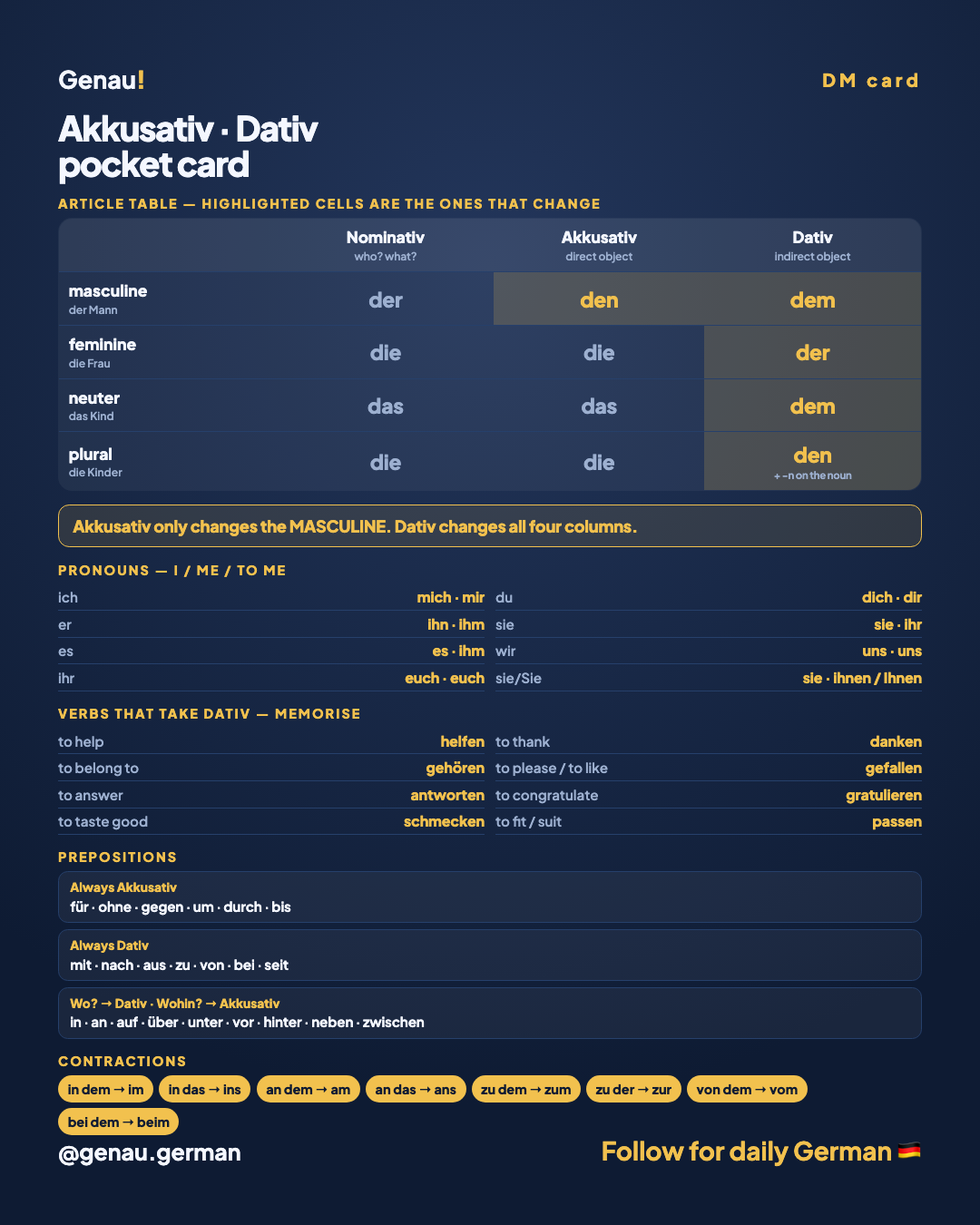
Akkusativ & Dativ pocket card
The whole topic on one page. Save it to your phone and scan it before the exam.
Related topics
Pronouns
mich or mir?
mich or mir — the full pronoun table and which case turns up when.
Verb + preposition
Ich warte auf dich
warten auf, denken an — the preposition a verb demands, plus wo(r)-/da(r)-.
mir ist kalt
cold · hungry · tired
Why «Ich bin kalt» is the wrong sentence, and how feelings are built with mir.