Ich bin Mir ist kalt
If you said Ich bin kalt, your grammar was fine and your meaning was not — they heard «I am a cold person». English pushes almost every feeling through I am. German splits them into three boxes: mir ist + adjective, ich habe + noun, ich bin + adjective. Below: the 31-line card, four traps, and the part nobody mentions — Mir ist kalt has no subject in it at all.
You already sort feelings into boxes in English
English does not put everything into I am either — you just stopped noticing. You say I have a headache, not I am headachy. You say I am tired, not I have tiredness. You say I am in a hurry, not I hurry. Nobody taught you which phrase takes which frame. You absorbed it word by word.
German draws the same kind of lines, only in different places — and it kept a third frame that English mostly retired. That third one is behind Mir ist kalt, and it is the whole reason Ich bin kalt lands wrong.
Mir ist kalt.
I am cold. — the cold is happening to me.
Ich bin kalt.
Reads as «I am a cold person» — distant, unfeeling. Perfectly grammatical, completely not what you meant.
There is no logic to reason your way to here. It is a filing system: three boxes, and every feeling word lives in exactly one of them.
The three boxes
| Box | Frame | What it says | Examples |
|---|---|---|---|
| 1 — sensation | mir ist + adjective | what your body feels right now, and it will pass | Mir ist kalt. · Mir ist schlecht. |
| 2 — carried | ich habe + noun | a feeling you are carrying around — the noun is capitalised and takes no article | Ich habe Hunger. · Ich habe Angst. |
| 3 — identity | ich bin + adjective | a state you are in, or a property of you — not just this minute | Ich bin müde. · Ich bin krank. |
Box 3 is the default. Box 1 is small and closed. Box 2 is a list of nouns you collect one at a time.
Box 1 is the surprising one, so start there. It covers temperature (kalt · heiß · warm), feeling unwell (schlecht · übel · schwindelig · unwohl) and boredom (langweilig). For how your body feels, that is the whole of it — the list does not grow, so you are never left guessing. One neighbouring family borrows the same frame for attitudes rather than sensations: Das ist mir egal. · Das ist mir peinlich. · Mir ist klar, dass…
Mir ist heiß.
I am hot — the room, the weather, the walk uphill.
Mir ist warm.
I have warmed up. Said in a coat, in a heated room, after coffee.
Box 2 is where English and German agree more often than you expect. You already say I have a fever, I have a cough, I have a cold. German simply keeps going: hunger, thirst, fear and luck are all things you have.
The card — 31 lines you will actually use
This is the part to save. Read the middle column out loud; the right-hand column is where people lose the sentence.
| What you mean | German | Box | Watch out |
|---|---|---|---|
| I am cold | Mir ist kalt. | mir ist | Ich bin kalt = I am a cold person |
| I am hot (temperature) | Mir ist heiß. | mir ist | Ich bin heiß is read as «I am attractive / turned on» |
| I have warmed up | Mir ist warm. | mir ist | — |
| I feel sick, queasy | Mir ist schlecht. | mir ist | Ich bin schlecht = I am bad at it |
| I feel nauseous | Mir ist übel. | mir ist | the phrase to use at the doctor’s |
| I am dizzy | Mir ist schwindelig. | mir ist | also spelled schwindlig |
| I am bored | Mir ist langweilig. | mir ist | Ich bin langweilig = I am boring |
| Something feels off | Mir ist unwohl. | mir ist | unease, not illness |
| I am getting cold | Mir wird kalt. | mir ist | wird = it is starting now |
| My feet are cold | Mir sind die Füße kalt. | mir ist | a body part becomes the subject → sind |
| My head hurts | Mir tut der Kopf weh. | same family | wehtun also puts the person in the dative |
| I am hungry | Ich habe Hunger. | ich habe | capital H, no article |
| I am thirsty | Ich habe Durst. | ich habe | — |
| I am afraid | Ich habe Angst. | ich habe | Ich habe Angst vor dem Hund. |
| I am homesick | Ich habe Heimweh. | ich habe | — |
| I am in pain | Ich habe Schmerzen. | ich habe | plural noun in German |
| I have a headache | Ich habe Kopfschmerzen. | ich habe | one word, plural |
| I have a fever | Ich habe Fieber. | ich habe | — |
| I am lucky | Ich habe Glück. | ich habe | Ich habe Pech = I am unlucky |
| I am in a hurry | Ich habe es eilig. | ich habe | this one keeps its es |
| I feel like a coffee | Ich habe Lust auf einen Kaffee. | ich habe | Lust auf + Akkusativ |
| I am stressed | Ich habe Stress. | ich habe | — |
| You are right | Du hast recht. | ich habe | recht and Recht are both allowed |
| I am tired | Ich bin müde. | ich bin | Mir ist müde does not exist |
| I am full (after eating) | Ich bin satt. | ich bin | Ich bin voll = I am drunk |
| I am ill | Ich bin krank. | ich bin | Ich bin erkältet = I have a cold |
| I am sad | Ich bin traurig. | ich bin | — |
| I am happy | Ich bin glücklich. | ich bin | — |
| I am done / wiped out | Ich bin fertig. | ich bin | both meanings live in one phrase; tone decides |
| I am annoyed | Ich bin sauer. | ich bin | colloquial, and everywhere |
| I am fine (answer to Wie geht es dir?) | Mir geht’s gut. | its own frame | never Ich bin gut |
Do not memorise this in one sitting. Take the five lines that describe your own week — the tram in January, the second coffee, the evening you were done — and put those in your notebook tonight.
Nobody mentions this: the sentence has no subject
Look at Mir ist kalt again. There is no ich in it. There is no subject at all. mir is dative — the person something is being done to — and the verb sits at plain third person singular because it has nothing to agree with. That is exactly why Ich bin kalt feels so natural to you and is still wrong: you are supplying a subject the sentence never asked for.
And this frame is not foreign to English. It is the ghost of something English used to do constantly: methinks (it seems to me), woe is me, it likes me not. You still use the surviving version every day — it seems to me, it feels cold to me. German just never dropped it.
| Form | German | English |
|---|---|---|
| plain | Mir ist kalt. | I am cold. |
| past | Mir war kalt. | I was cold. |
| becoming | Mir wird kalt. | I am getting cold. |
| already happened | Mir ist kalt geworden. | I have got cold. |
| negative | Mir ist nicht kalt. | I am not cold. |
| question | Ist dir kalt? | Are you cold? |
| softened | Mir ist ein bisschen kalt. | I am a little cold. |
The adjective never changes and never takes an ending here: kalt, not kalter.
To talk about someone else, you do not touch the verb. You swap one pronoun and stop.
| Person | Dative | Example |
|---|---|---|
| ich | mir | Mir ist kalt. |
| du | dir | Ist dir kalt? |
| er | ihm | Ihm ist heiß. |
| sie (she) | ihr | Ihr ist schlecht. |
| wir | uns | Uns ist langweilig. |
| ihr | euch | Ist euch warm? |
| sie (they) | ihnen | Ihnen ist kalt. |
| Sie (formal) | Ihnen | Ist Ihnen kalt? |
| a person, named | dative article | Meiner Frau ist kalt. |
| a child | dative article | Dem Kind ist kalt. |
The verb stays ist for every single one of them. That is the payoff of having no subject: nothing to conjugate for.
One exception you can see coming: if you name a body part, that part is the subject, and the verb agrees with it. Mir sind die Füße kalt. — plural feet, so sind. Mir ist die Hand kalt. — one hand, so ist.
Four traps — one wrong box each
Temperature words describe your character in box 3
Mir ist kalt.
I am cold. → correct, and it is about right now.
Ich bin kalt.
I am a cold person — emotionally shut. Or, literally, cold to the touch.
The same trap runs one degree hotter: Ich bin heiß is not «I am warm». Colloquially it means «I am attractive» or «I am turned on». On a summer platform in Frankfurt you want Mir ist heiß, plainly.
«Ich bin voll» at the dinner table
Danke, ich bin satt.
Thanks, I am full. → the phrase you want after a meal.
Ich bin voll.
Colloquially: I am drunk. Said at a family lunch, it lands badly.
satt is a word English does not really have — «full» is your only option in English, so nothing in your head is holding the slot open. Learn it as a phrase, not a word: Ich bin satt, danke.
The answer to «Wie geht es dir?» is not «Ich bin gut»
Wie geht es dir? — Mir geht’s gut, danke.
How are you? — I am fine, thanks.
Ich bin gut.
I am good at this / I am a good person. Not an answer to the question.
Notice the dative again, in both halves: dir in the question, mir in the answer. The question literally asks «how does it go to you» — the same construction as Mir ist kalt, wearing a different verb. Short version in shops and corridors: Gut, danke.
«Ich bin hungrig» is not a mistake — it is just not said
Ich habe Hunger.
I am hungry. → what people actually say.
Ich bin hungrig.
Grammatically correct. Rare in speech, and it marks you as translating.
Keep these two categories apart, because teachers often blur them. Ich bin kalt is wrong — it says something else. Ich bin hungrig is correct but unusual — nobody misunderstands you, you just sound like a textbook. Same for Ich bin durstig.
Where the boxes leak
Three clean boxes make a good carousel. Here is what the carousel did not have room for.
- Box 1 does not grow. Temperature, feeling unwell, boredom — that is close to the entire membership. You cannot extend it by analogy: Mir ist müde and Mir ist glücklich are not German.
- Cold has a second, fully correct form, and it is a verb. Ich friere. = I am cold, I am freezing — no box at all, and stronger than Mir ist kalt. Its opposite behaves the same way: Ich schwitze. = I am sweating.
- Some feelings have two legal forms. Mir ist langweilig and Ich habe Langeweile are both correct. So are Ich bin erkältet and Ich habe eine Erkältung. Pick one and move on.
- The adjectives are ordinary adjectives about objects. Das Wasser ist kalt. Die Suppe ist heiß. The box only applies when the thing feeling cold is a person.
- Spelling has two winners. recht haben and Recht haben are both permitted since the reform. If someone corrects you, they are stating a preference, not a rule.
- You will meet Es ist mir kalt. It exists, mostly in older or literary text. It is not the everyday form. Start your sentence with Mir and you are never wrong.
- Box 2 nouns can take an article once they are described. Ich habe Angst. stands bare — but Ich habe große Angst. and Ich habe einen Riesenhunger. are both normal. The bare form is the default, not a ban.
There is no rule that tells you which box a word lives in
Why is tiredness a property (Ich bin müde) while dizziness is a sensation (Mir ist schwindelig)? Both pass in twenty minutes. There is no principle underneath it — the assignment is historical, and native speakers cannot explain it either.
So do not hunt for the logic. The payoff of knowing the three boxes is not that you can derive new words; it is that your ear starts flagging the wrong frame a second after it leaves your mouth. That second is where the correction happens.
What you just learned
You just walked in from the snow. What do you say?
Show the answer
Mir ist kalt. Box 1 — the cold is happening to you, so you go in the dative and the sentence has no subject. Ich bin kalt describes your personality. Ich habe kalt is the French pattern (j’ai froid) and does not exist in German.
How do you tell a friend you are hungry?
Show the answer
Ich habe Hunger. Box 2 — a feeling you carry, expressed as a noun: capital H, no article. Ich bin hungrig is grammatical but rarely said; Mir ist Hunger is not German at all, because box 1 only takes adjectives.
Wie geht es dir? — ___
Show the answer
Mir geht’s gut. The question already puts you in the dative (dir), and the answer keeps you there (mir). Ich bin gut means «I am good at this». Mir ist gut is not a reply anyone gives; the negative Mir ist nicht gut does exist, but it means «I feel unwell», not «I am not fine».
How to write this in your notebook
Single words are what created the problem. kalt = cold is a true entry and a useless one, because it tells you nothing about the frame the word has to sit in.
- ✗ kalt = cold
- ✓ Mir ist kalt. = I am cold — box 1: mir ist + adjective
- ✗ Hunger = hunger
- ✓ Ich habe Hunger. = I am hungry — box 2: capital noun, no article
Give one notebook page three columns — mir ist · ich habe · ich bin — and file every new feeling word into a column the day you meet it. Within two weeks the first column stops filling up. That is not you running out of material; that is you finishing box 1.
The live check while speaking: if the sentence is about how your body feels this minute and you are about to open with Ich bin, stop and open with Mir. That single habit removes most of the mistakes on this page.
Five phrases a week is enough. Box 1 will be complete in a fortnight. Boxes 2 and 3 you will be filling for years, and that is fine — those are the ones nobody laughs at.
Build the sentence yourself
Tap the words and put them in order. This is the hardest part of German — and there are no options to pick from, you build it.
-
tap the words
-
tap the words
Know this before the test
The core of the topic in three lines, then the mistakes people make most often.
- The feeler goes in the dative
Mir ist kalt/heiß/schlecht/langweilig/schwindelig. The grammatical subject is a silent es.
Mir ist kalt.
- Ich bin … changes the meaning
Ich bin kalt = I'm a cold person · Ich bin langweilig = I'm boring. The pattern isn't optional — it protects you.
Mir ist langweilig ≠ Ich bin langweilig
- Hunger and thirst take haben
Ich habe Hunger/Durst. These two never use the dative pattern.
Ich habe Hunger.
- Questions keep the dative
Ist dir kalt? · Wie geht es dir? — answer: Mir geht's gut.
Ist dir kalt?
Ich bin kalt.
Mir ist kalt.
The subject version describes your personality.
Mir ist Hunger.
Ich habe Hunger.
Hunger is a haben-noun, not a dative feeling.
Bist du kalt?
Ist dir kalt?
The question keeps the dative too.
Ich bin heiß.
Mir ist heiß.
The subject version means something very different.
Test yourself
Tap an answer — we will look at why together.
You just walked in from the snow. What do you say?
How do you tell a friend you are hungry?
Wie geht es dir? —
How are you? — answer it
You have eaten enough and want to decline a second helping.
«I'm bored.» — the safe version?
«I feel sick / nauseous.» —
schlecht = bad; the pattern decides the meaning
Practice done — –
To finish the topic, take the full test: score 60% and it is marked as done on your level path.
0/6 · questions answered
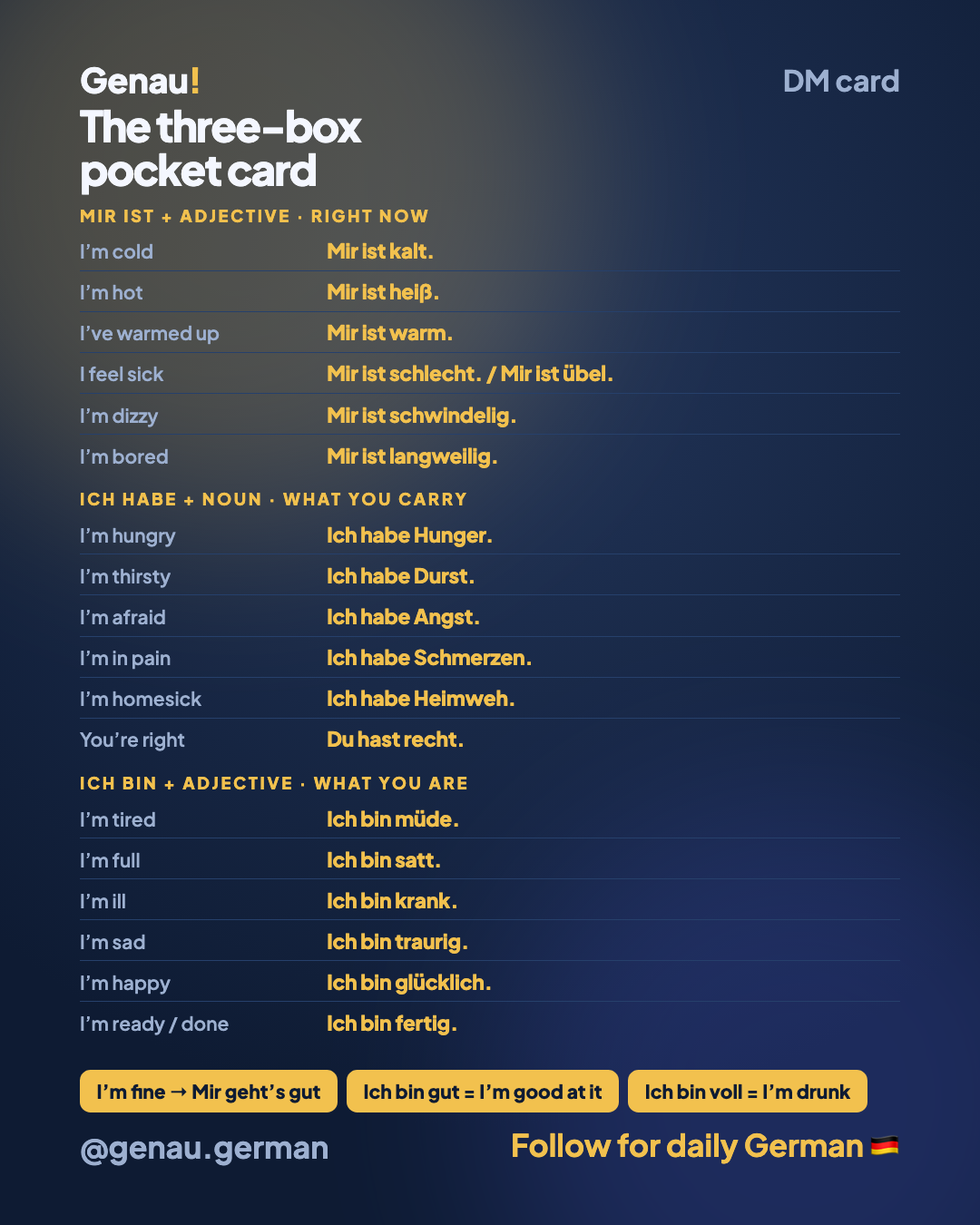
The three feeling boxes
The whole topic on one page. Save it to your phone and scan it before the exam.