Ich verstehe nur Bahnhof
Somebody speaks, you catch nothing, and your mouth goes empty. The problem is almost never your vocabulary — it is speed, and the fact that nobody ever taught you the three sentences that buy you time. Here is the full kit: 18 lines sorted by how much room they leave you, three traps, and the one follow-up move that actually fixes a sentence instead of repeating it.
You already own this kit in English
You have never studied how to say «I didn’t understand» in English, yet you own about ten versions of it. Sorry? · Come again? · You’ve lost me. · It’s all Greek to me. And you pick between them without thinking — one of them you would say to a friend, and one of them you would never say to a border officer.
German asks you for exactly the same thing. Same three moves — signal · ask for a repeat · ask for slower — and the same instinct about which room you are in. You are not learning a new logic here. You are picking up a new set of keys for a lock you already know.
Ich verstehe nur Bahnhof.
Literally «I only understand train station». It is the German for «it’s all Greek to me».
Ich nicht verstehe.
English word order carried straight across. In German the conjugated verb sits in slot two: Ich verstehe nicht.
If you remember one line from this page, make it Entschuldigung, ich habe das nicht verstanden. It works in every room in Germany, including the ones where a joke would cost you.
What is actually inside «Ich verstehe nur Bahnhof»
| Word | Means | Worth knowing |
|---|---|---|
| ich | I | — |
| verstehe | understand | from verstehen — to understand |
| nur | only | — |
| Bahnhof | train station | Bahn (rail) + Hof (yard). A noun, so it is written with a capital letter — always. |
Say it: ikh fair-SHTAY-uh noor BAHN-hof. The ch in ich is not a hard k — it is the soft hiss at the start of the English word «huge».
Word for word it says «I only understand train station». What it means is: I got nothing. Not one idea landed.
The story Germans tell is from 1918. The First World War was ending, and the soldiers coming back from the front had exactly one thing in their heads: the train home. Whatever an officer said to them, the only word that stuck was Bahnhof. The phrase never left the language.
Honest version: that origin is the popular one, not a proven one. You will also find an account set in Berlin, where everyone in earshot was talking about departures. Dictionaries mark the origin as uncertain. Tell the 1918 story — just do not defend it as fact.
Entschuldigung, ich verstehe nur Bahnhof.
Sorry, I don’t understand a thing. — Opening with «Entschuldigung» takes the edge off. Nobody is offended; most people smile.
The rescue kit — the part you save
Sorted by how much room they leave you. The top of the list is what you reach for when a sentence has just gone past you; the bottom is what you reach for when you know exactly which word broke it.
| Say this | What it means | Register | Reach for it when |
|---|---|---|---|
| Wie bitte? | Sorry? / Pardon? | any room | the whole sentence went past you and you need one second |
| Entschuldigung? | Excuse me? | any room | same job, slightly softer, works as an opener too |
| Ich habe das nicht verstanden. | I didn’t understand that. | any room | your safest sentence in Germany — no register can reject it |
| Ich verstehe nicht. | I don’t understand. | any room | shorter, present tense, fine everywhere |
| Ich verstehe Sie nicht. | I don’t understand you. | formal (Sie) | the person, not the topic — noisy street, fast talker, bad line |
| Was haben Sie gesagt? | What did you say? | formal (Sie) | you want the words back, not an explanation |
| Was hast du gesagt? | What did you say? | casual (du) | friends, flatmates, anyone you are on du terms with |
| Ich verstehe nur Bahnhof. | It’s all Greek to me. | casual only | friends, small talk, a laugh — not the Amt, not the doctor |
| Können Sie das bitte wiederholen? | Could you repeat that, please? | formal (Sie) | you want the same sentence again |
| Kannst du das bitte wiederholen? | Could you repeat that, please? | casual (du) | same line, du version |
| Können Sie bitte langsamer sprechen? | Could you speak more slowly, please? | formal (Sie) | the real fix, nine times out of ten |
| Etwas langsamer, bitte. | A bit slower, please. | any room | when a whole question feels like too much machinery |
| Noch einmal, bitte. | Once more, please. | any room | short, polite, impossible to get wrong |
| Können Sie das bitte anders sagen? | Could you put that differently? | formal (Sie) | the repeat did not help — you need a different sentence |
| Was bedeutet «Anmeldung»? | What does «Anmeldung» mean? | any room | you caught everything except one word |
| Können Sie das bitte buchstabieren? | Could you spell that, please? | formal (Sie) | names, streets, email addresses on the phone |
| Können Sie das bitte aufschreiben? | Could you write that down, please? | formal (Sie) | appointment times, room numbers, anything you must not get wrong |
| Ich lerne noch Deutsch. | I’m still learning German. | any room | buys you patience before you even need it |
Bonus, and free: swap können for könnten and every line above gets one shade politer — Könnten Sie das bitte wiederholen? Germans use it constantly at counters and in offices. Nothing else in the sentence changes.
Three traps
None of these are grammar mistakes. All three are right sentence, wrong room — which is the mistake that actually costs you something.
«Bahnhof» in a room that is not laughing
The idiom is casual. Among friends it is charming and it makes you sound like you live here. At the Ausländerbehörde, at the doctor’s, in a job interview, it lands as a joke told at the wrong moment — and the person across the desk now has to decide whether you are being funny or whether you genuinely did not follow.
Entschuldigung, ich habe das nicht verstanden.
Sorry, I didn’t understand that. — The formal-room version. Neutral, complete, impossible to misread.
Ich verstehe nur Bahnhof. (in the job interview)
Grammatically perfect. Socially expensive.
The idiom is also fixed — you do not decorate it. Ich verstehe nur den Bahnhof is perfectly grammatical German, but the article kills the idiom and the sentence goes back to meaning «the only thing I understand is the train station». No article, no plural. Four words, exactly as they are.
Honest note: this is a risk, not a ban. Plenty of Germans would find it warm even at work. But you cannot read that room yet in a second language, so at A1 keep the idiom where it is safe.
The bare «Was?»
Was? on its own is the German equivalent of barking «What?» at someone. Between friends it is completely normal and you will hear it a hundred times a day. From a stranger, in an office, at a counter, it reads as blunt.
Wie bitte?
Sorry? — Same length, same speed, no edge.
Was? (to the person at the counter)
Not wrong German. Wrong room.
And the reverse warning: Wie bitte? said sharply, with the stress climbing, turns into «I beg your pardon?» — the offended one. English does exactly the same thing with «Excuse me?». Keep it flat and it stays polite.
Where «nicht» goes
English puts the negative early: «I don’t understand you.» German puts the conjugated verb in slot two and lets nicht fall late — but short objects like das · Sie · dich · es squeeze in before it.
Ich verstehe Sie nicht.
I don’t understand you.
Ich verstehe das nicht.
I don’t understand that.
Ich verstehe nicht Sie.
This says «it is not you I understand — it is someone else». A different sentence entirely.
Rule of thumb that holds at A1: verb second, nicht last, short pronouns cut the line.
The grammar hiding in your two safest sentences
You only need two shapes. One present, one past. Learn them as shapes, not as rules, and you can rebuild them under pressure.
| Shape | Sentence | What is doing the work |
|---|---|---|
| present | Ich verstehe das nicht. | verstehe in slot two · nicht at the end |
| past (Perfekt) | Ich habe das nicht verstanden. | habe in slot two · verstanden pushed to the very end |
Germans reach for the past one more often than you would expect, because the not-understanding already happened. Both are correct; the Perfekt just sounds a little more finished.
Here is the piece almost nobody flags at A1: the past participle is verstanden — with no ge-. Not geverstanden. German verbs that begin with an unstressed prefix (ver- · be- · er- · ent- · ge- · zer- · emp-) never take the ge-: verstanden · bekommen · erklärt · entschieden.
| Person | Form | Full line |
|---|---|---|
| ich | verstehe | Ich verstehe das nicht. |
| du | verstehst | Verstehst du das? |
| er · sie · es | versteht | Er versteht kein Deutsch. |
| wir | verstehen | Wir verstehen uns. |
| ihr | versteht | Versteht ihr mich? |
| sie · Sie | verstehen | Verstehen Sie mich? |
No vowel change anywhere — verstehen is one of the calm ones. Note that Wir verstehen uns has drifted in meaning: it is «we get along», not «we understand each other’s words».
Nobody taught you this: a repeat is the weakest move you have
Watch what happens when you say Können Sie das bitte wiederholen? Most people repeat the same sentence, at the same speed, only louder. If the sentence broke because of a word or the pace, a louder copy of it breaks in exactly the same place.
So stop asking for the sentence back. Ask for a different one, or name the part you did catch. Three moves, in order of how much they fix:
Können Sie das bitte anders sagen?
Could you put that differently? — Forces a new sentence with new words. This is the one that actually works.
Ich habe nur «Termin» verstanden.
I only understood «Termin». — You hand them the broken piece, so they repair precisely instead of guessing.
Habe ich das richtig verstanden: Ich komme am Montag um zehn Uhr?
Did I get that right: I come on Monday at ten? — Say the content back in your own words. If you are wrong, they correct you in one second instead of ten minutes.
That last one is the whole game. Repeating back is what interpreters, nurses and air traffic controllers do, and it is the single fastest way to sound like someone who is managing a conversation rather than drowning in it.
They will switch to English on you
In most German cities, the moment someone hears you struggle, they switch to English. It is meant kindly. It also ends your practice for the day.
Auf Deutsch, bitte. Ich lerne noch.
In German, please. I’m still learning. — Friendly, short, and it works about half the time.
The other half of the time they will keep going in English anyway, especially when there is a queue behind you. That is not a failure of your sentence. Take the English, get the thing done, and try again where nobody is waiting.
And the honest headline of this whole page: most of the time the problem is not your vocabulary, it is speed. langsamer sprechen will rescue you more often than any word list ever will. Note the shape of that word: it is langsamer, never mehr langsam. German builds the comparative by adding -er, however long the adjective — langsam → langsamer, deutlich → deutlicher, interessant → interessanter. There is no German «more slowly». A handful are irregular (gut → besser, viel → mehr) and some short adjectives take an umlaut (alt → älter), but langsam does neither.
What you just learned
You are at the Ausländerbehörde. The officer says something and you catch none of it. What comes out of your mouth?
Show the answer
Entschuldigung, ich habe das nicht verstanden. All three are real German. But Bahnhof is an idiom for friends, and a bare Was? reads as blunt from a stranger. The middle one is the line no room can reject.
You need the sentence slower. Which is the natural ask?
Show the answer
Können Sie bitte langsamer sprechen? — The polite machine is always Können Sie bitte …? — the bare imperative sounds like an order.
«What does that mean?» —
Show the answer
Was bedeutet das? — Word meaning takes bedeuten. A person's intent takes meinen — Was meinst du?
Put it in your notebook like this
Do not file these as vocabulary. You will never look them up in time. File them as three reflexes, and drill them until they arrive in half a second instead of three.
- 1 · SIGNAL — Entschuldigung, ich habe das nicht verstanden. Buys you the room’s attention without a joke.
- 2 · REPAIR — Können Sie das bitte anders sagen? Gets a new sentence instead of a louder one.
- 3 · CONFIRM — Habe ich das richtig verstanden: …? Closes the loop so you leave with the right information.
Next to each one, write the room you will use it in — bakery, landlord, doctor, Amt. A line without a room stays theory. A line with a room turns into a memory the first time you use it.
Then say all three out loud, ten times, today. Not to memorise them — to make your mouth able to produce them while your brain is still panicking. That is the actual skill here.
One week is enough for this page. One line a day, used on a real person, beats the whole table read silently.
Build the sentence yourself
Tap the words and put them in order. This is the hardest part of German — and there are no options to pick from, you build it.
-
tap the words
-
tap the words
-
tap the words
Know this before the test
The core of the topic in three lines, then the mistakes people make most often.
- Four lifesavers
Wie bitte? · Können Sie das bitte wiederholen? · Können Sie bitte langsamer sprechen? · Ich habe das nicht verstanden. Memorise them as sounds — they buy you time everywhere.
Wie bitte?
- Meaning questions come in a pair
Was bedeutet das? asks what a word means. Wie sagt man … auf Deutsch? asks how to say something. Fixed phrase: auf Deutsch.
Was bedeutet das?
- Spelling is a verb
buchstabieren = to spell aloud. On the phone, for names and addresses: Können Sie das buchstabieren?
Können Sie das buchstabieren?
- Asking is normal
Germans ask for repeats constantly. Nodding along costs you dates, amounts and appointments — the polite repair phrases exist to be used.
Entschuldigung, ich habe das nicht verstanden.
Was?!
Wie bitte?
Bare Was? sounds rude; bitte makes it the standard «pardon?».
Wie sagt man das in Deutsch?
Wie sagt man das auf Deutsch?
The fixed phrase takes auf.
Nodding and hoping
Können Sie das bitte wiederholen?
Pretending to understand is the only real mistake here.
Sprechen Sie langsam!
Können Sie bitte langsamer sprechen?
The bare imperative reads as an order; the Können Sie…? frame keeps it polite.
Test yourself
Tap an answer — we will look at why together.
You are at the Ausländerbehörde. The officer says something and you catch none of it. What comes out of your mouth?
Ich habe das nicht .
verstehen → verstanden (no ge- with ver-)
The repeat did not help. Which line asks for a different sentence rather than a louder copy of the same one?
«I don’t understand you.» — which one is it?
You need the sentence slower. Which is the natural ask?
«What does that mean?» —
Practice done — –
To finish the topic, take the full test: score 60% and it is marked as done on your level path.
0/6 · questions answered
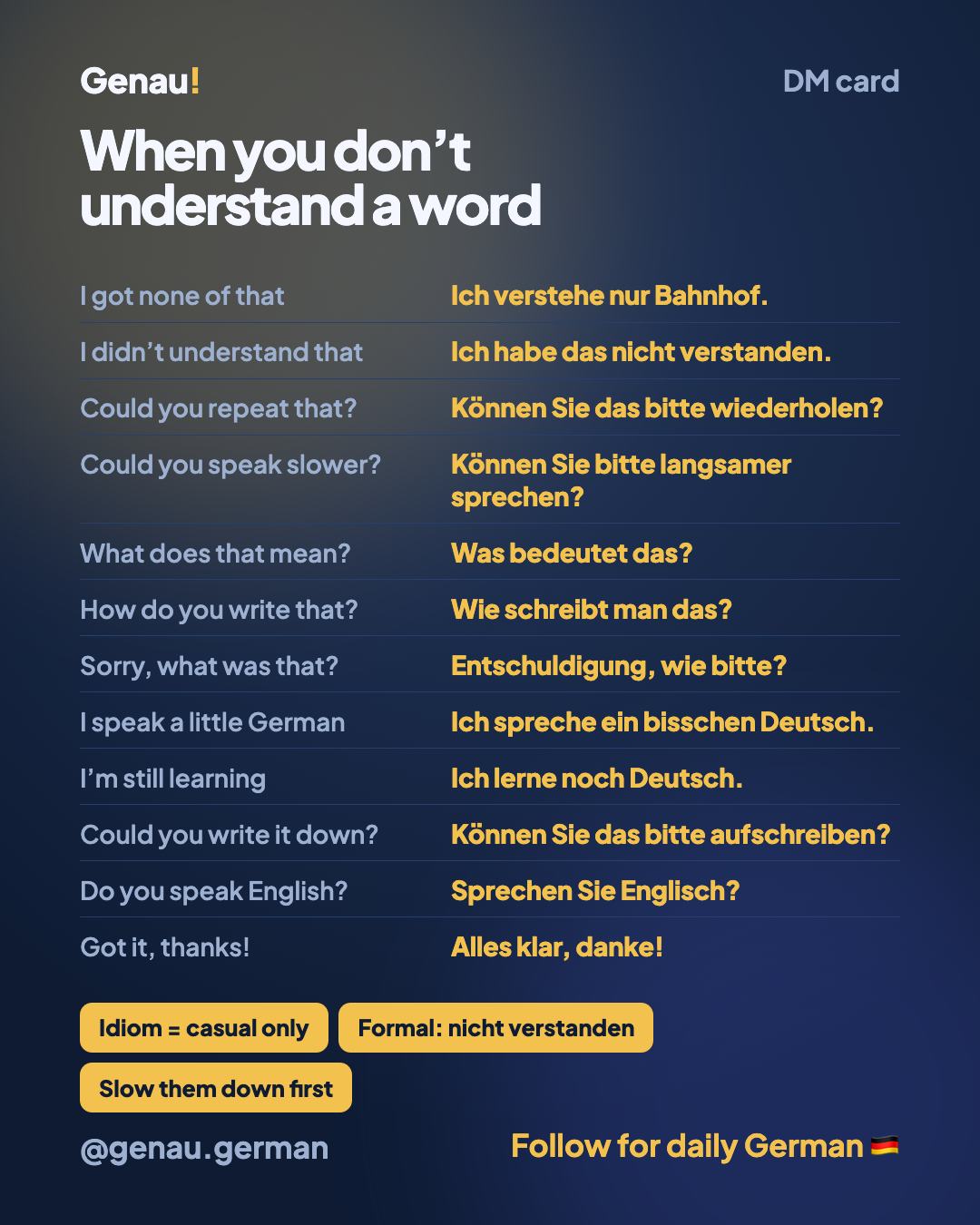
The «I didn’t understand» kit
The whole topic on one page. Save it to your phone and scan it before the exam.
Related topics
Akkusativ & Dativ
the full article table
Accusative vs dative: what actually changes, and what never moves at all.
mir ist kalt
cold · hungry · tired
Why «Ich bin kalt» is the wrong sentence, and how feelings are built with mir.
Modalpartikeln
doch · mal · ja · halt
doch · mal · ja — the small words that stop you sounding like a robot.