Ich habe bin nach Berlin gefahren
You don’t need two past tenses in German. When Germans talk, they use the Perfekt and almost nothing else — and English already hands you the shape for free. The only thing English never says is Ich bin gegangen, and that single line is the whole difficulty. Below: the full decision table, the complete sein list, every ge- rule, and the places where the rule quietly leaks.
English already builds this sentence
Look at what you do in English without thinking: I have eaten. Two parts — a helper verb, then a past participle. You never say I have eat, and you never stop to work out why. That structure is already in your head.
German uses exactly the same build. The helper goes in position 2, the participle drops to the very end. Nothing new so far.
Ich habe eine Pizza gegessen.
I ate a pizza. — helper in slot 2, participle last.
Then German does the one thing English refuses to do: for some verbs it swaps the helper. Not haben but sein — literally «I am gone».
Ich bin nach Berlin gefahren.
I went to Berlin. — «I am travelled», in English terms.
Ich habe nach Berlin gefahren.
Wrong. Your English reflex reached for «have» — and German heard it.
So there is really only one question on this page: haben or sein? Everything else you already own.
One more piece of relief before the tables. German has a second past tense (Präteritum: ich ging, ich machte), but in spoken German it has mostly retreated into books and news reports. If your goal is talking, the Perfekt is the past tense you build. One tense, not two.
The decision table — the part you save
Read this table in one direction only: infinitive → participle → helper. The helper column is the one that decides your sentence.
| Infinitiv | Partizip II | Helper | Meaning | Example |
|---|---|---|---|---|
| machen | gemacht | haben | to do, to make | Ich habe die Hausaufgaben gemacht. |
| kaufen | gekauft | haben | to buy | Ich habe ein Auto gekauft. |
| arbeiten | gearbeitet | haben | to work (extra -e-) | Ich habe drei Stunden gearbeitet. |
| trinken | getrunken | haben | to drink | Wir haben Kaffee getrunken. |
| essen | gegessen | haben | to eat | Ich habe eine Pizza gegessen. |
| sehen | gesehen | haben | to see | Ich habe den Film gesehen. |
| lesen | gelesen | haben | to read | Er hat das Buch gelesen. |
| schreiben | geschrieben | haben | to write | Ich habe eine E-Mail geschrieben. |
| sprechen | gesprochen | haben | to speak | Ich habe mit ihm gesprochen. |
| nehmen | genommen | haben | to take | Ich habe den Bus genommen. |
| schlafen | geschlafen | haben | to sleep (a state, not a change) | Ich habe gut geschlafen. |
| helfen | geholfen | haben | to help | Er hat mir geholfen. |
| studieren | studiert | haben | to study (no ge-) | Ich habe in Wien studiert. |
| besuchen | besucht | haben | to visit (no ge-) | Ich habe meine Oma besucht. |
| einkaufen | eingekauft | haben | to shop (ge- inside) | Ich habe im Supermarkt eingekauft. |
| anrufen | angerufen | haben | to call (ge- inside) | Ich habe dich gestern angerufen. |
| gehen | gegangen | sein | to go — movement | Ich bin nach Hause gegangen. |
| kommen | gekommen | sein | to come — movement | Sie ist zu spät gekommen. |
| fahren | gefahren | sein / haben | to travel / to drive sth. — see Trap 01 | Ich bin nach Berlin gefahren. |
| fliegen | geflogen | sein / haben | to fly — same split as fahren | Wir sind nach Rom geflogen. |
| laufen | gelaufen | sein | to run, to walk — movement | Er ist zehn Kilometer gelaufen. |
| aufstehen | aufgestanden | sein | to get up — movement | Ich bin früh aufgestanden. |
| einschlafen | eingeschlafen | sein | to fall asleep — change of state | Das Kind ist sofort eingeschlafen. |
| passieren | passiert | sein | to happen — change of state | Was ist passiert? |
| sterben | gestorben | sein | to die — change of state | Mein Großvater ist letztes Jahr gestorben. |
| werden | geworden | sein | to become — pure memorisation | Sie ist Ärztin geworden. |
| bleiben | geblieben | sein | to stay — pure memorisation | Wir sind zu Hause geblieben. |
| sein | gewesen | sein | to be — pure memorisation | Ich bin noch nie in Japan gewesen. |
Notice what the haben half of the table looks like: eating, buying, reading, calling, working. Ordinary verbs. That is the whole point — haben is the default, and the exceptions are listed in the next section in full.
The statistical shortcut, said plainly: the overwhelming majority of German verbs take haben. If you are mid-sentence and genuinely have no idea, saying habe is not a coin flip — it is standing on the right side of the odds.
You only memorise one side — and it is the short one
Here is the relief nobody puts on slide one. You are not memorising which verbs take haben — that list is endless. You memorise the sein list, and then every verb not on it takes haben automatically.
Three families fill the list: movement from A to B, change of state, and three outliers that obey nothing.
| Verb | Partizip II | Why sein | Example |
|---|---|---|---|
| gehen | gegangen | movement | Ich bin ins Kino gegangen. |
| kommen | gekommen | movement | Er ist gestern gekommen. |
| fahren | gefahren | movement (no object) | Wir sind nach Hamburg gefahren. |
| fliegen | geflogen | movement (no object) | Ich bin nach Rom geflogen. |
| laufen | gelaufen | movement | Sie ist zum Bahnhof gelaufen. |
| rennen | gerannt | movement | Ich bin zum Bus gerannt. |
| reisen | gereist | movement | Ich bin durch Europa gereist. |
| steigen | gestiegen | movement | Er ist auf den Berg gestiegen. |
| fallen | gefallen | movement | Das Glas ist auf den Boden gefallen. |
| ankommen | angekommen | movement | Der Zug ist pünktlich angekommen. |
| aufstehen | aufgestanden | movement | Ich bin um sechs aufgestanden. |
| einschlafen | eingeschlafen | change of state | Ich bin vor dem Fernseher eingeschlafen. |
| aufwachen | aufgewacht | change of state | Ich bin früh aufgewacht. |
| wachsen | gewachsen | change of state | Das Kind ist schnell gewachsen. |
| sterben | gestorben | change of state | Er ist im Winter gestorben. |
| passieren | passiert | change of state | Was ist gestern passiert? |
| werden | geworden | outlier — memorise | Sie ist Lehrerin geworden. |
| bleiben | geblieben | outlier — memorise | Wir sind zu Hause geblieben. |
| sein | gewesen | outlier — memorise | Ich bin noch nie in Japan gewesen. |
That is the list you carry. Roughly twenty verbs — and the ten at the top are verbs you say every single day anyway.
Honest footnote: this is the working list, not the complete inventory. A few more genuinely take sein and you will meet them later — begegnen (Ich bin ihm begegnet.), folgen (Ich bin ihm gefolgt.), gelingen (Es ist mir gelungen.). Nobody at A2 will hold those against you.
Where does ge- go?
The helper is half the sentence. The other half is the participle — and there are exactly four things that can happen to ge-. Learn the four and you can build a participle for a verb you have never seen.
| Verb type | What happens to ge- | Pattern | Examples |
|---|---|---|---|
| Regular (weak) | ge- in front, -t at the end | ge + stem + t | machen → gemacht · kaufen → gekauft · sagen → gesagt |
| Irregular (strong) | ge- in front, -en at the end, vowel often changes | ge + stem + en | trinken → getrunken · sprechen → gesprochen · schreiben → geschrieben |
| Stem ends in -t / -d / -fn / -gn | an extra -e- is pushed in so you can pronounce it | ge + stem + et | arbeiten → gearbeitet · warten → gewartet · öffnen → geöffnet · regnen → geregnet |
| Verbs in -ieren | no ge- at all | stem + t | studieren → studiert · telefonieren → telefoniert · reparieren → repariert · passieren → passiert |
| Inseparable prefix | no ge- at all — the prefix already sits there | prefix + stem + t/en | besuchen → besucht · verstehen → verstanden · erklären → erklärt · entscheiden → entschieden |
| Separable prefix | ge- moves inside, between prefix and verb | prefix + ge + stem + t/en | anrufen → angerufen · einkaufen → eingekauft · mitbringen → mitgebracht · fernsehen → ferngesehen |
The inseparable prefixes worth knowing by heart: be- · ge- · er- · ver- · zer- · ent- · emp- · miss-. None of them ever lets a ge- in front.
How do you tell a separable prefix from an inseparable one without a dictionary? Say the infinitive out loud. If the stress lands on the prefix (ANrufen · EINkaufen · AUFstehen) it separates and ge- goes inside. If the stress lands on the verb (beSUchen · verSTEhen · erKLÄren) there is no ge-.
And there is a third group nobody bothers to name for you: the mixed verbs. They take the strong vowel change and the weak -t ending at the same time. There are only a handful, and you use all of them constantly.
| Infinitiv | Partizip II | Helper | Example |
|---|---|---|---|
| bringen | gebracht | haben | Ich habe dir Blumen gebracht. |
| denken | gedacht | haben | Ich habe an dich gedacht. |
| kennen | gekannt | haben | Ich habe ihn gut gekannt. |
| nennen | genannt | haben | Er hat keinen Namen genannt. |
| wissen | gewusst | haben | Ich habe es nicht gewusst. |
| rennen | gerannt | sein | Ich bin schnell gerannt. |
Two participles that look like they forgot to change
Ich habe meinen Schlüssel vergessen.
I forgot my key. — vergessen → vergessen, identical to the infinitive.
Ich habe ein Geschenk bekommen.
I got a present. — bekommen → bekommen, also identical.
They are not mistakes and they are not missing a ge-. Both are strong verbs with an inseparable prefix, so the rule says «no ge-, keep the -en ending» — and the result happens to look exactly like the infinitive.
Three traps that break real sentences
Same verb, two helpers — the object decides
Ich bin nach Berlin gefahren.
I went to Berlin. — no object, you were simply travelling → sein
Ich habe das Auto gefahren.
I drove the car. — there is an object, you operated something → haben
The verb did not change; the sentence around it did. Ask yourself one thing: did I move, or did I move something? Moved → sein. Moved something → haben.
Ich habe meinen Bruder nach Hause gefahren.
I drove my brother home. — «my brother» is the object → haben
Der Pilot hat das Flugzeug geflogen.
The pilot flew the plane. — same split with fliegen.
The same double life shows up with fliegen · segeln · reiten · schwimmen · tanzen. Journey from A to B → sein. Activity with an object, or just the activity itself → haben: Wir haben die ganze Nacht getanzt. versus Wir sind durch den Saal getanzt.
No movement anywhere — and still sein
Ich bin zu Hause geblieben.
I stayed home. — staying is the opposite of movement, and it still takes sein.
Es ist kalt geworden.
It got cold.
Ich bin noch nie in Japan gewesen.
I have never been to Japan.
This is the point where the «movement rule» you were taught stops covering the ground. sein · bleiben · werden sit outside it entirely. There is no logic to reconstruct here — three verbs, pure memorisation, and then you are done.
Related and easy to mix up: einschlafen (to fall asleep) is a change of state → Ich bin eingeschlafen. But schlafen (to sleep) is just a state → Ich habe gut geschlafen. Same root, different helper.
The participle is not allowed to sit next to its helper
Ich habe gegessen eine Pizza.
Wrong. English word order transplanted straight into German.
Ich habe gestern eine Pizza gegessen.
I ate a pizza yesterday. — everything else squeezes in between.
The helper claims position 2 and the participle claims the last position. Everything else in the sentence — time, place, objects — gets packed in the middle. Germans call the two ends a Satzklammer, a sentence bracket: the sentence is held shut at both ends.
| Sentence type | Where the helper sits | Where the participle sits | Example |
|---|---|---|---|
| Normal statement | position 2 | very end | Ich habe gestern Pizza gegessen. |
| Starting with the time | still position 2 — the subject slides behind it | very end | Gestern habe ich Pizza gegessen. |
| Yes/no question | position 1 | very end | Hast du das Buch gelesen? |
| W-question | position 2 | very end | Wann bist du angekommen? |
| Subordinate clause (weil, dass …) | very end — after the participle | second to last | …, weil ich zu viel gegessen habe. |
The last row is the one that surprises people: in a weil-clause the two parts swap places. Participle first, helper last.
This is also why nobody interrupts you mid-sentence to correct you. A German ear waits for the end — the verb information does not arrive until you finish. Say the participle, or the sentence never lands.
Nobody told you: English used to do this too
«I am gone» feels impossible in English. It was not always. For most of the history of English, verbs of motion and change took be, exactly like German takes sein — and the sentences are still sitting in the language where you can read them.
- Christ is risen. — not «has risen»
- The time is come.
- Winter is come.
- He is gone. — the one that survived into everyday speech
- I’m finished. · She’s grown. — the pattern still leaking through today
Over the nineteenth century English quietly let have take over everything, and the be-perfect faded into a handful of frozen phrases. German never made that switch. Neither did French (je suis allé), Italian (sono andato) or Dutch (ik ben gegaan).
So Ich bin gegangen is not a strange German invention you have to tolerate. It is the older European pattern — English is the odd one out, and you are the one who has to re-learn something your own language dropped. That reframe is worth more than any mnemonic: you are not fighting German logic, you are restoring a switch English turned off.
It also tells you which verbs to expect on the list. The English survivors are all motion and change — come, go, rise, grow, finish. That is precisely the German sein list.
What you just learned
Ich ___ gestern ins Kino gegangen. (I went to the cinema yesterday)
Show the answer
bin. gehen is movement from A to B, so it takes sein. Your English reflex reaches for «have» — that is exactly the one place English will not help you.
Ich habe dich gestern ___. (anrufen — to call)
Show the answer
angerufen. anrufen has a stressed, separable prefix, so ge- slides inside: an-ge-rufen. Compare the other direction: an unstressed prefix or an -ieren verb gets no ge- at all — besucht, studiert.
Which sentence is correct?
Show the answer
Ich habe gestern eine Pizza gegessen. The helper holds position 2, the participle holds the very end, and everything else is packed between them. Move the time word to the front and the bracket still holds: Gestern habe ich eine Pizza gegessen.
Where the rule leaks — and how to write it down
Four places this page is not the whole truth. You should hear them from a page, not from a German looking confused at you.
- haben, sein and the modal verbs normally stay in the Präteritum. Ich bin gewesen is correct, but people say Ich war. Same for Ich hatte, Ich musste, Ich wollte. Build the Perfekt for everything else; leave these four in the simple past.
- Regional split. sitzen · stehen · liegen take haben in the north (Ich habe gesessen.) and sein in the south, Austria and Switzerland (Ich bin gesessen.). Both are correct where they are spoken. Nothing to fix.
- fahren, fliegen, schwimmen, tanzen and friends work both ways. The helper depends on the sentence, not on the verb. There is no list that can save you here — only Trap 01.
- The «90% haben» figure is a rule of thumb, not a measurement. It is true enough to bet a sentence on and not true enough to quote as a fact.
Now the practical part. This topic is not solved by studying it — it is solved by changing how you write verbs down. If your notebook says gehen = to go, you will do the arithmetic again every single time you open your mouth.
- ❌ gehen = to go
- ✅ gehen — ist gegangen = to go — Ich bin ins Kino gegangen.
- ❌ anrufen = to call
- ✅ anrufen — hat angerufen = to call — Ich habe dich gestern angerufen.
Three boxes, always: infinitive + helper + participle, then one sentence from your own life. Write ist or hat in front of the participle every time — that tiny word is the entire decision, stored where you will see it.
Do the sein list first. About twenty verbs, one evening. After that every new verb you meet is haben until proven otherwise — and you will almost never have to prove otherwise.
Build the sentence yourself
Tap the words and put them in order. This is the hardest part of German — and there are no options to pick from, you build it.
-
tap the words
-
tap the words
-
tap the words
Know this before the test
The core of the topic in three lines, then the mistakes people make most often.
- The frame: helper + … + participle
Ich habe gestern eine Pizza gegessen. Helper in slot 2, participle parked at the end.
Ich habe … gegessen.
- Regular ge…t, strong ge…en
gemacht · gekauft vs gegessen · gefahren. Strong participles are learned with the verb.
machen → gemacht · essen → gegessen
- sein for motion and change
gehen · fahren · aufstehen · bleiben · werden take sein. Anything with a direct object takes haben — even Ich habe das Auto gefahren.
Ich bin gegangen. · Ich habe gegessen.
- Prefixes control ge-
Separable: ge- goes inside — angerufen. Inseparable (ver-/be-/er-): no ge- — verstanden. -ieren: no ge- — studiert.
angerufen · verstanden · studiert
Ich habe ins Kino gegangen.
Ich bin ins Kino gegangen.
Motion takes sein.
geverstanden
verstanden
Inseparable prefixes block ge-.
gestudiert
studiert
-ieren verbs never take ge-.
Ich habe gegessen gestern eine Pizza.
Ich habe gestern eine Pizza gegessen.
The participle owns the final slot.
Test yourself
Tap an answer — we will look at why together.
Ich gestern ins Kino gegangen. (I went to the cinema yesterday)
Ich das Auto gefahren. (I drove the car)
Ich habe dich gestern . (anrufen — to call)
I called you yesterday.
Which sentence is correct?
Wir zu Hause geblieben.
We stayed at home.
Ich habe das nicht . (verstehen)
I didn't understand that.
Practice done — –
To finish the topic, take the full test: score 60% and it is marked as done on your level path.
0/6 · questions answered
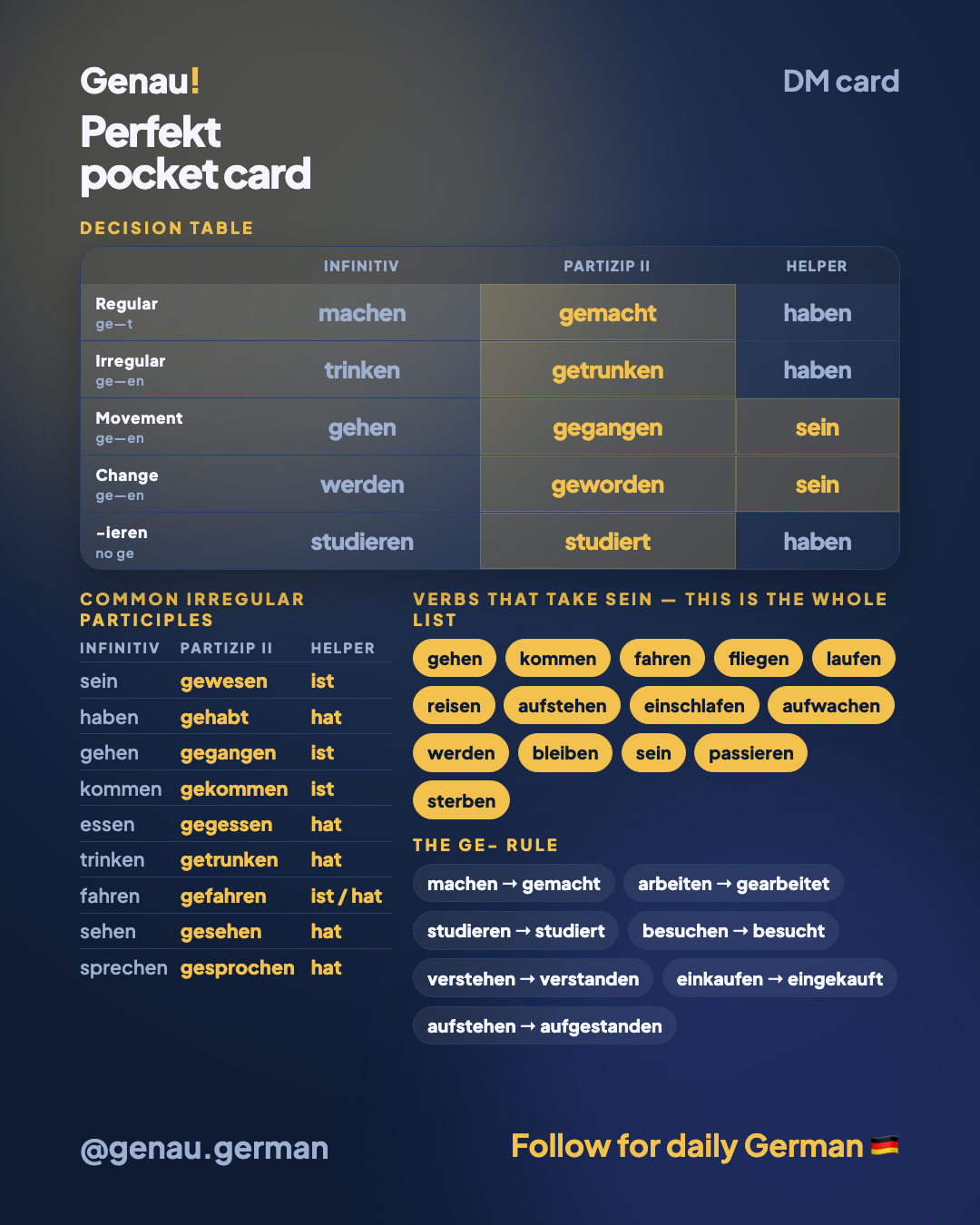
Perfekt pocket card
The whole topic on one page. Save it to your phone and scan it before the exam.
Related topics
Pronouns
mich or mir?
mich or mir — the full pronoun table and which case turns up when.
Akkusativ & Dativ
the full article table
Accusative vs dative: what actually changes, and what never moves at all.
Verb + preposition
Ich warte auf dich
warten auf, denken an — the preposition a verb demands, plus wo(r)-/da(r)-.