die das Mädchen
If you are learning articles word by word, you are doing thousands of small jobs instead of about twenty-five. In most German nouns the ending tells you the article, and in a compound the last chunk decides — however long the word gets. Below: the full ending table, the endings that are genuinely watertight, three named traps, and the honest list of where the rules break.
You already read word endings in English
Read this word: reticulation. You have probably never seen it, and you still know three things about it instantly — it is a noun, it is abstract, and it is a thing rather than a person. Nobody taught you that. You learnt to read the ending -tion and stopped thinking about it.
You do the same with -ness (a quality), -ship (a state or relation), -er (someone who does it), -ism (a system of ideas), -let (a small one). English endings carry information, you read it automatically, and you never called it grammar.
German runs exactly this system, with one extra piece of information stapled on: the ending also tells you der, die or das. Not the meaning of the word. Not whether the thing is male, female or an object. The last few letters.
Die Wohnung ist klein.
The flat is small. → the ending is -ung, so it is die. You did not need to know the word.
Der Kapitalismus ist ein System.
Capitalism is a system. → -ismus, so der. Same word you already know in English.
Das Dokument liegt auf dem Tisch.
The document is on the table. → -ment, so das.
That is the whole method. You are not learning gender for every noun — you are learning about twenty-five endings, once. The rest of this page is that list, plus the places where it is honestly not enough.
One thing to drop straight away: German gender has nothing to do with real-world gender. das Mädchen (girl) is neuter, die Person is feminine even when it is your brother. Treat der · die · das as three arbitrary boxes with three arbitrary labels.
The ending table — this is the part you save
Read this once slowly, then never again as a block. You will meet these endings ten times a day and they fix themselves. The How safe column is the important one — some of these rows have no exceptions at all, and some are a coin flip with a thumb on the scale.
| Ending | Article | English cousin | How safe | Examples |
|---|---|---|---|---|
| -ung | die | -ing · -tion | watertight as a suffix | die Wohnung · die Zeitung · die Meinung · die Übung |
| -heit | die | -ness · -hood | no exceptions | die Freiheit · die Krankheit · die Kindheit |
| -keit | die | -ness · -ity | no exceptions | die Möglichkeit · die Schwierigkeit |
| -schaft | die | -ship | no exceptions | die Freundschaft · die Wissenschaft · die Mannschaft |
| -tion · -sion | die | identical | no exceptions | die Nation · die Information · die Explosion |
| -tät | die | -ty | no exceptions | die Universität · die Qualität · die Realität |
| -anz · -enz | die | -ance · -ence | very high | die Distanz · die Konferenz · die Existenz |
| -ie | die | -y (biology) | very high — but das Genie | die Biologie · die Familie · die Energie |
| -ei | die | — | very high | die Bäckerei · die Polizei · die Datei |
| -ur | die | -ure | high — but das Abitur · der Flur | die Natur · die Kultur · die Temperatur |
| -ik | die | -ic · -ics | high | die Musik · die Politik · die Grammatik |
| -e | die | — | weakest rule on the page — see trap 02 | die Lampe · die Blume · die Frage |
| -er (a doer) | der | -er (teacher) | high only for doers — see trap 03 | der Lehrer · der Fahrer · der Computer |
| -ling | der | -ling (duckling) | no exceptions | der Frühling · der Schmetterling · der Zwilling |
| -ismus | der | -ism | no exceptions | der Kapitalismus · der Tourismus · der Realismus |
| -or | der | -or | high — but das Labor | der Motor · der Professor · der Autor |
| -ig · -ich | der | — | high | der Honig · der König · der Teppich |
| -ant · -ent (a person) | der | -ant · -ent | high for people only | der Student · der Praktikant · der Präsident |
| -chen | das | -let · -ie (doggie) | no exceptions | das Mädchen · das Brötchen · das Märchen |
| -lein | das | -let | no exceptions | das Fräulein · das Büchlein · das Vöglein |
| -ment | das | -ment | very high — but der Moment · der Zement | das Dokument · das Instrument · das Medikament |
| -um | das | -um (museum) | very high — but der Konsum | das Zentrum · das Museum · das Datum · das Studium |
| -tum | das | -dom (Christendom) | high — two exceptions, both common | das Eigentum · das Wachstum — but der Reichtum · der Irrtum |
| -nis | das | -ness | mostly das, a handful die | das Ergebnis · das Erlebnis · das Geheimnis — but die Kenntnis · die Erlaubnis |
| -zeug | das | — | no exceptions | das Werkzeug · das Flugzeug · das Spielzeug |
| -ing (English loanword) | das | straight from English | reliable — but der Pudding | das Training · das Meeting · das Marketing |
Do not try to hold twenty-six rows in your head. Hold four: -ung · -heit · -keit · -schaft are die and never anything else. Those four alone cover a large slice of every abstract noun in the language, and they are free from today.
Notice the shape of the list: the die block is by far the longest. That is not an accident — German builds most of its abstract vocabulary with feminine suffixes. If you are guessing blind on a long, abstract-sounding noun, die is the best bet you have.
The part that is free because you speak English
English and German split from the same parent, then English borrowed the same Latin vocabulary German did. The result: a whole layer of German nouns is a word you already own, wearing a slightly different ending — and that ending hands you the article.
| Your English ending | Becomes | Article | A word you already know |
|---|---|---|---|
| -tion | -tion | die | information → die Information · nation → die Nation |
| -ty | -tät | die | university → die Universität · quality → die Qualität |
| -ness · -hood | -heit · -keit | die | childhood → die Kindheit · possibility → die Möglichkeit |
| -ship | -schaft | die | friendship → die Freundschaft · membership → die Mitgliedschaft |
| -ance · -ence | -anz · -enz | die | distance → die Distanz · existence → die Existenz |
| -y (as in -ology) | -ie | die | biology → die Biologie · energy → die Energie |
| -ure | -ur | die | nature → die Natur · culture → die Kultur |
| -ism | -ismus | der | tourism → der Tourismus · optimism → der Optimismus |
| -or | -or | der | motor → der Motor · professor → der Professor |
| -ent · -ant (people) | -ent · -ant | der | student → der Student · president → der Präsident |
| -ment | -ment | das | instrument → das Instrument · argument → das Argument |
| -um | -um | das | museum → das Museum · album → das Album |
| -dom | -tum | das | Christendom → das Christentum · growth → das Wachstum |
| -ing (loanwords) | -ing | das | training → das Training · meeting → das Meeting |
Nine of these fourteen rows land on die. If a German noun looks Latin, sounds academic and could appear in an English essay, feminine is the sensible default.
There is one thing English gives you that speakers of French, Spanish or Italian do not get: nothing to unlearn. They arrive with a gender for every noun already installed, and German ignores it. The sun is die Sonne in German and masculine in Spanish; the moon is der Mond in German and feminine in Spanish. Gender does not travel between languages. You start clean.
Three named traps
The ending beats the meaning. Always.
Das Mädchen liest ein Buch.
The girl is reading a book. → -chen is the diminutive ending, and every diminutive is neuter. It does not care that the word means «girl».
Die Mädchen liest ein Buch.
Wrong. You went by meaning. Worse: die Mädchen does exist — it is the plural — so this reads as «the girls is reading».
The same machine produces das Brötchen (bread roll), das Häuschen (little house), das Fräulein. A real diminutive usually umlauts the stem as well: Haus → Häuschen, Buch → Büchlein, Vogel → Vöglein.
And this cuts the other way too: die Person stays feminine when it is a man, das Kind stays neuter for a boy or a girl, die Wache (the guard) is feminine whoever is standing there. Meaning is not the input.
Careful with lookalikes: der Kuchen (cake) and der Knochen (bone) end in the letters -chen but are not diminutives — there is no small «Ku» or «Kno». If the word does not mean «a little X», it is not the suffix.
-e is the weakest rule on the page
Roughly three out of four nouns in -e are die: die Lampe · die Blume · die Sprache · die Frage · die Straße. Useful, but that last quarter contains some of the most common words in the language.
- der — der Name · der Junge · der Käse · der Kollege · der Buchstabe · der Gedanke · der Löwe · der Hase
- das — das Ende · das Auge · das Interesse · das Gebäude · das Gemüse
Ich habe eine Frage.
I have a question. → -e behaving normally: feminine, so eine.
Wie ist dein Name?
What is your name? → not deine. Name is one of the masculine -e words, and this is the sentence you will say on day one.
Practical rule: if you are going to be suspicious of anything on this page, be suspicious of an -e word. Everywhere else, trust the ending and move on.
-er is not a gender ending — it is a job description
Most lists print «-er → der» flat, and then you meet die Mutter and lose confidence in the whole method. The rule is narrower than the lists admit: -er means der when the word is built from a verb and means the one who does it.
Der Lehrer erklärt die Regel.
The teacher explains the rule. → lehren (to teach) + -er = the one who teaches. This is the ending working.
Das Fenster ist offen.
The window is open. → a window does not «fenst». No verb behind it, so the -er tells you nothing.
Der Fenster ist offen.
Wrong. You applied the doer rule to a word that is not a doer.
| -er word | Article | Why |
|---|---|---|
| der Fahrer · der Sprecher · der Verkäufer | der | built from fahren · sprechen · verkaufen — a doer |
| der Computer · der Kalender · der Pullover | der | loanwords that joined the doer group anyway |
| die Mutter · die Schwester · die Tochter | die | ancient family words, older than the suffix |
| die Butter · die Leiter · die Feier | die | not doers, and feminine |
| das Fenster · das Wasser · das Messer | das | not doers, and neuter |
| das Zimmer · das Theater · das Wetter | das | not doers, and neuter |
Test before you use the rule: can you say «someone who …s»? If yes, take der. If not, the ending is silent and you learn that word individually.
No ending? Then go by group
Short, old, everyday nouns often have no suffix at all — Tisch · Baum · Hund · Bier. For those there is a second, weaker system: categories of meaning. Treat it as a set of good bets rather than rules, and note the exceptions written next to each row, because those are exactly the words you will use first.
| Group | Article | Examples | Watch out |
|---|---|---|---|
| Days · months · seasons | der | der Montag · der Januar · der Sommer | reliable |
| Weather and compass points | der | der Regen · der Schnee · der Wind · der Norden | die Sonne · das Eis · das Wetter |
| Male people and animals | der | der Vater · der Bruder · der Hahn | das Mädchen · das Kind |
| Alcoholic drinks | der | der Wein · der Wodka · der Schnaps | das Bier — of course |
| Car makes | der | der BMW · der Golf · der Audi | motorbikes and ships go die |
| Rocks and minerals | der | der Stein · der Granit · der Diamant | reliable |
| Numbers used as nouns | die | die Eins · die Null · die Million | das Hundert · das Tausend |
| Flowers and trees | die | die Rose · die Tulpe · die Eiche · die Tanne | der Ahorn · der Kaktus |
| Most fruits and berries | die | die Banane · die Kirsche · die Erdbeere | der Apfel · der Pfirsich |
| Female people | die | die Frau · die Mutter · die Tochter | the -chen words override this |
| Ships | die | die Titanic · die Queen Mary | reliable |
| Young living things | das | das Kind · das Baby · das Lamm · das Kalb | reliable |
| Metals and elements | das | das Gold · das Silber · das Eisen · das Kupfer | der Stahl · die Bronze |
| Colours used as nouns | das | das Rot · das Blau · das Grün | reliable |
| Languages and letters | das | das Deutsch · das Englisch · das große A | usually used with no article at all |
| Countries and cities | das | das schöne Italien · das moderne Berlin | die Schweiz · die Türkei · der Iran |
| Verbs used as nouns | das | das Essen · das Lernen · das Leben · das Schwimmen | no exceptions — 100% |
One row in this table is a real rule and the rest are bets. Take any infinitive, write it with a capital letter, and it is a neuter noun: schwimmen → das Schwimmen. That is an infinite supply of nouns whose article you will never have to look up.
Das Essen ist fertig.
Dinner is ready. → essen (to eat) turned into a noun, so das. No exceptions to check.
Der Montag ist mein freier Tag.
Monday is my day off. → days of the week are masculine, and so is der Tag itself.
Honest limit: these groups are patterns somebody noticed afterwards, not laws. If a group bet fails you twice on the same word, stop betting and learn that word with its article, the way you learn an irregular verb.
The part nobody teaches: in a compound, the last chunk decides
You already know this rule in English and were never told it either. A houseboat is a boat. A boathouse is a house. A bus stop is a stop, not a bus. The final word carries the identity; everything in front of it is description.
German does the same thing, glues it all into one word, and adds one consequence: the article comes from the last chunk too. Nothing else in the word matters.
Die Haustür ist offen.
The front door is open. → das Haus + die Tür. It is a door, so it is die.
Das Haustür ist offen.
Wrong. You took the article from Haus, the first chunk. The front of a compound never decides anything.
Der Apfelbaum steht im Garten.
The apple tree is in the garden. → Baum decides; Apfel is only telling you which kind.
| Compound | Built from | Last chunk | Article |
|---|---|---|---|
| die Haustür | das Haus + die Tür | Tür | die |
| der Apfelbaum | der Apfel + der Baum | Baum | der |
| der Handschuh | die Hand + der Schuh | Schuh | der |
| die Autobahn | das Auto + die Bahn | Bahn | die |
| das Wörterbuch | das Wort + das Buch | Buch | das |
| der Geburtstag | die Geburt + der Tag | Tag | der |
| die Jahreszeit | das Jahr + die Zeit | Zeit | die |
| das Flugzeug | der Flug + das Zeug | Zeug | das |
| der Arbeitsplatz | die Arbeit + der Platz | Platz | der |
| die Krankenversicherung | krank + die Versicherung | Versicherung → -ung | die |
| das Fußballspiel | der Fußball + das Spiel | Spiel | das |
The little -s- and -en- that appear between chunks (Arbeitsplatz · Krankenversicherung) are glue, not grammar. They change nothing about the article.
Now the famous monster: die Donaudampfschifffahrtsgesellschaft — Danube-steam-ship-travel-company. Forty-something letters, and you answer it with the last ten: Gesellschaft → -schaft → die. You did not need to understand a single other syllable.
This is why long German words are the wrong thing to be afraid of. A long word is small words glued together, and it hands you both the meaning and the article in its final chunk. The genuinely hard German words are the short ones: Tisch · Stuhl · Buch · Bier. No ending, no compound, nothing to read.
Two chunks combined can also form a word whose two ends are read differently — der See (lake) and die See (sea) are two words spelled the same. Rare, but it exists, and no ending rule will save you there.
What you just learned
___ Zeitung
Show the answer
die. The ending is -ung, and as a suffix it has no exceptions. You never have to think about a noun in -ung again: die Wohnung · die Meinung · die Rechnung.
das Auto + die Bahn = ___ Autobahn
Show the answer
die. In a compound only the last chunk votes, and this thing is a Bahn. Taking das from Auto is reading the word from the wrong end.
Why learn nouns WITH their article?
Show the answer
Gender drives every later ending — cases, adjectives, pronouns — Every case ending and adjective ending depends on gender. Tisch alone is half a word; der Tisch is the whole unit.
How to put this in your notebook
The single change that fixes this topic is not studying harder. It is refusing, from today, to ever write a German noun on its own. A bare noun is not a German word — it is half of one.
- ❌ Tisch = table
- ✅ der Tisch, die Tische = table — article and plural in the same breath
- ❌ Wohnung = flat
- ✅ die Wohnung, die Wohnungen — and mark it: -ung, so die, no thinking required
Take the plural at the same time on purpose. German plurals are as unpredictable as the articles, they cost nothing extra at the moment you first meet the word, and they cost a lot to bolt on six months later.
- When a new noun arrives, ask one question first: does it end in something from the table? If yes, do not memorise the article at all — you already have it, and memorising it again is wasted work.
- Keep a second, short list called «no ending, had to learn it». That is where der Tisch · das Bier · die Zeit live. It will stay surprisingly small.
- Say the word with its article, never alone — die Zeitung, not Zeitung. You are training your mouth, not your memory.
- Once a week, take five nouns you wrote down and say which rule each one falls under. If a word has no rule, it belongs on the short list.
- Every time you hesitate mid-sentence, write down the noun. Ten hesitations later you will see that the same eight words keep doing it — and eight words is an evening, not a year.
A last piece of perspective on getting it wrong. Article mistakes almost never destroy a sentence. Ich suche der Wohnung is wrong and everyone still understands you and answers. Fluency is not built by never risking an article — it is built by saying the sentence, taking the correction, and having a system that files the correction somewhere useful.
The honest summary: no ending on this page is a law of nature, and a small handful — -chen · -lein · -heit · -keit · -schaft · -tion — are close enough to one that you can bet on them without hesitating. Everything else beats guessing, and everything beats memorising thousands of nouns one at a time.
Build the sentence yourself
Tap the words and put them in order. This is the hardest part of German — and there are no options to pick from, you build it.
-
tap the words
-
tap the words
-
tap the words
Know this before the test
The core of the topic in three lines, then the mistakes people make most often.
- Suffixes decide hundreds of nouns
-ung · -heit · -keit · -ion · -schaft · -tät → die. -chen · -lein → das. -ling → der. Learn the suffix, get the noun free.
die Zeitung · das Mädchen · der Frühling
- Compounds: last word wins
der Zahn + der Arzt → der Zahnarzt · das Auto + die Bahn → die Autobahn. First word only narrows the meaning.
die Autobahn
- Meaning groups help
Days, months, seasons → der. Infinitives as nouns → das (das Schwimmen).
der Montag · das Rauchen
- Gender drives everything later
Cases, adjective endings and pronouns all read the gender first. That is why nouns are learned WITH their article, as one unit.
der Tisch → er → den Tisch
die Mädchen (singular)
das Mädchen
-chen is always neuter — grammar beats biology.
der Autobahn
die Autobahn
Last element die Bahn decides.
Learning nouns without articles
der Tisch, die Lampe, das Buch — as one word
Every later ending depends on the gender you skipped.
das Universität
die Universität
-tät is a reliable die-suffix.
Test yourself
Tap an answer — we will look at why together.
Zeitung
newspaper
Mädchen
girl
das Auto + die Bahn = Autobahn
motorway
Fenster
window
Freiheit
freedom
Häuschen (little house)
little house
Practice done — –
To finish the topic, take the full test: score 60% and it is marked as done on your level path.
0/6 · questions answered
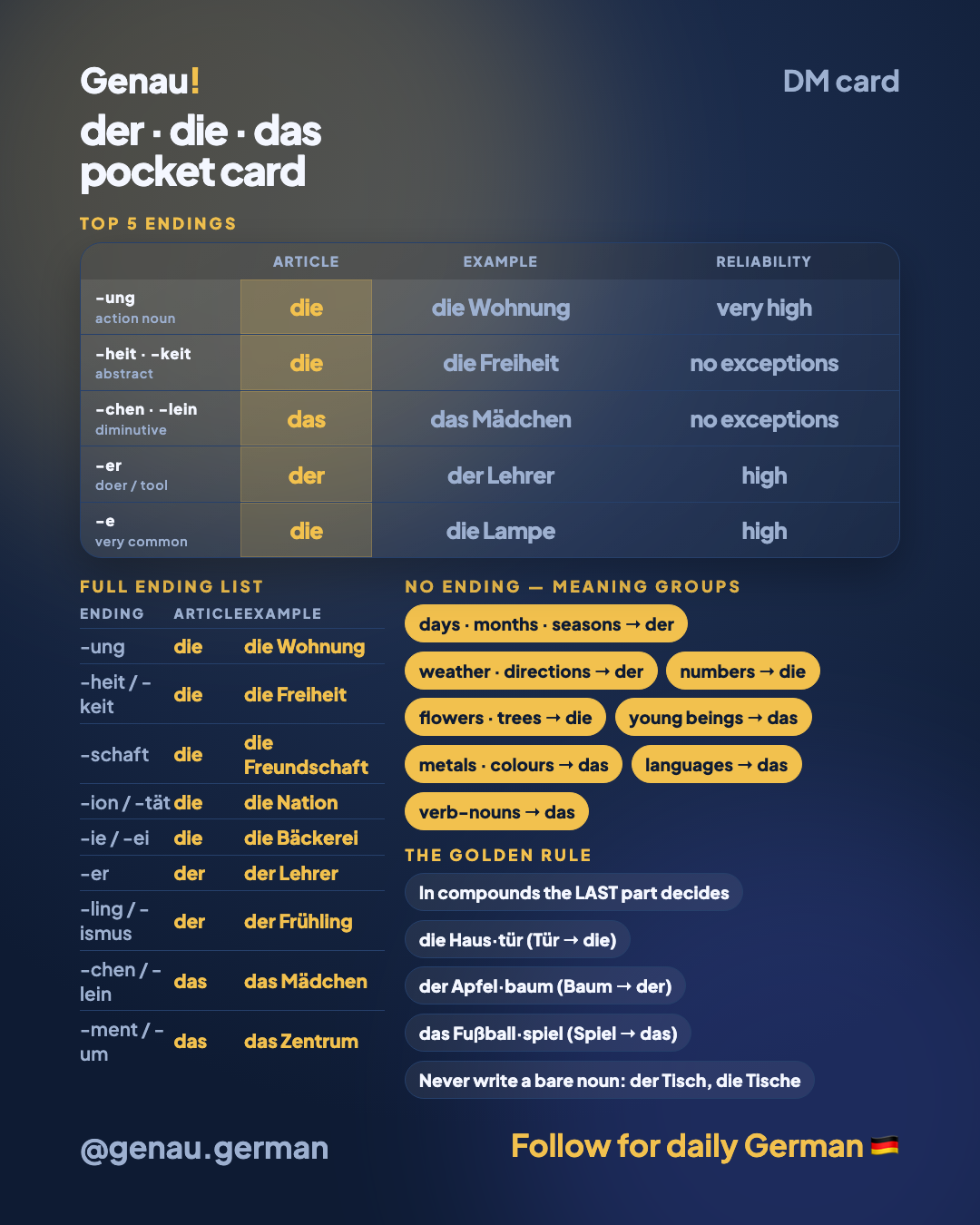
der/die/das pocket card
The whole topic on one page. Save it to your phone and scan it before the exam.
Related topics
Akkusativ & Dativ
the full article table
Accusative vs dative: what actually changes, and what never moves at all.
Pronouns
mich or mir?
mich or mir — the full pronoun table and which case turns up when.
mir ist kalt
cold · hungry · tired
Why «Ich bin kalt» is the wrong sentence, and how feelings are built with mir.