wo? · wohin? · woher?
Wechselpräpositionen
The questions wo?, wohin? and woher? ask about place and direction: with nine “two-way” prepositions, wohin? takes the Akkusativ (in die Küche) and wo? takes the Dativ (in der Küche).
“Ich gehe in der Park.” — place or direction, which one is it? English quietly keeps the two apart (in vs. into, on vs. onto). German uses one and the same preposition and lets the case decide: Dativ or Akkusativ.
You already do half of this in English
If you know the Akkusativ and Dativ table, this page covers the nine prepositions that let you choose between the two.
Shortcutwo? → Dativ (it stays) · wohin? → Akkusativ (it goes). Same preposition, two faces.
You never stop to think about the difference between into the kitchen and in the kitchen. One is arrival, the other is being there. Jump onto the table · sit on the table. Nobody taught you this as a table; the little word told you.
German asks for exactly the same reflex. There is one difference: the signal is not a separate word, it sits on the article. The preposition itself never changes — the only thing that changes is the article that follows it.
Ich gehe in die Küche.
I’m going into the kitchen. → arrival, Akkusativ
Ich bin in der Küche.
I’m in the kitchen. → being there, Dativ
English only does this for a couple of words (in/into, on/onto) and shrugs at the rest: behind the house means both. German has nine prepositions that split, and every one of them behaves the same way — the pairs below show it.
| English pair | Preposition | wohin? · where to | wo? · where |
|---|---|---|---|
| into · in | in | in die Küche | in der Küche |
| onto · on | auf | auf den Tisch | auf dem Tisch |
| (to) under · under | unter | unter das Bett | unter dem Bett |
| (to) in front of · in front of | vor | vor die Tür | vor der Tür |
| (to) behind · behind | hinter | hinter das Haus | hinter dem Haus |
| English pair | Preposition | wohin? · where to | wo? · where |
|---|---|---|---|
| (to) beside · beside | neben | neben den Stuhl | neben dem Stuhl |
| (in)between · between | zwischen | zwischen die Bücher | zwischen den Büchern |
| (to) above · above (in the air) | über | über das Sofa | über dem Sofa |
| (touching) onto · at | an | an die Wand | an der Wand |
So you are not learning a new kind of logic from scratch. You are taking a reflex you already have and moving it onto the article. The difficulty is not the rule, it is the moving.
These nine prepositions are called Wechselpräpositionen in German — “switching prepositions”. Every other preposition has a fixed case; there you have no choice, and nothing to think about.
The one question that decides it
You ask the sentence a single question: “wohin?” or “wo?” Is something going somewhere, or is it just sitting somewhere? Once you have the answer, you have the case.
- wohin? · where to? → something arrives somewhere new, a boundary is crossed → Akkusativ
- wo? · where? → the place where it already is is described, no boundary → Dativ
Ich stelle die Tasse auf den Tisch.
I’m putting the cup on the table. → the cup wasn’t on the table, now it arrives there: Akkusativ
Die Tasse steht auf dem Tisch.
The cup is (standing) on the table. → it isn’t going anywhere, we’re giving its location: Dativ
Ich stelle die Tasse auf dem Tisch.
Wrong — there is a putting action, the cup is heading for a target. It has to be auf den Tisch.
Now the real work: you have answered the question, so what does the article become? The four rows below are the engine of this page. der is masculine, die feminine, das neuter — and in the plural it is die again.
| Word | wohin? → Akkusativ | wo? → Dativ |
|---|---|---|
| der Tisch — masculine | auf den Tisch | auf dem Tisch |
| die Wand — feminine | an die Wand | an der Wand |
| das Bett — neuter | unter das Bett | unter dem Bett |
| die Bücher — plural | zwischen die Bücher | zwischen den Büchern |
| ein Tisch — indefinite | auf einen Tisch | auf einem Tisch |
| eine Wand — indefinite | an eine Wand | an einer Wand |
| mein Garten — possessive | in meinen Garten | in meinem Garten |
| meine Tasche — possessive | in meine Tasche | in meiner Tasche |
In the Akkusativ only the masculine changes: der → den. Feminine, neuter and plural stay the same. In the Dativ all four change, and in the plural the noun gets an extra –n: die Bücher → den Büchern.
It is the target, not the verb, that decides. “If the verb shows movement, use the Akkusativ” works in week one and misleads you in week two — you will see why in section 5.
The nine prepositions — the table to save
The list is closed and short: nine. No other preposition offers this choice. What you need to memorise is not “which preposition takes which case” — it is which prepositions are on this list of nine.
| Preposition | Meaning | wohin? + Akkusativ | wo? + Dativ |
|---|---|---|---|
| in | into · in | in den Park | im Park |
| an | touching: at a vertical surface, an edge | an die Wand | an der Wand |
| auf | onto · on (horizontal surface) | auf den Tisch | auf dem Tisch |
| über | above (not touching) · over | über das Sofa | über dem Sofa |
| unter | under | unter das Bett | unter dem Bett |
| Preposition | Meaning | wohin? + Akkusativ | wo? + Dativ |
|---|---|---|---|
| vor | in front of | vor die Tür | vor der Tür |
| hinter | behind | hinter das Haus | hinter dem Haus |
| neben | next to · beside | neben den Stuhl | neben dem Stuhl |
| zwischen | between | zwischen die Stühle | zwischen den Stühlen |
The cheapest way to keep the list in your head: three + two + four. in–an–auf (contact), über–unter (above–below), vor–hinter–neben–zwischen (surroundings). If you can stand in a room and point to each one, you have the list.
One row in the table looks odd: next to in den Park it says im Park. That is because some preposition + article pairs fuse in German, and writing them apart sounds wrong.
| Spelled out | Fused form | Which case | Example |
|---|---|---|---|
| in + das | ins | Akkusativ | Ich gehe ins Kino. |
| in + dem | im | Dativ | Ich bin im Kino. |
| an + das | ans | Akkusativ | Ich gehe ans Fenster. |
| an + dem | am | Dativ | Ich stehe am Fenster. |
| auf + das | aufs | Akkusativ | Ich freue mich aufs Wochenende. |
These are the ones that are required in writing. In speech you will also hear unterm · unters · vorm · vors · hinterm · übers — that is everyday talk; on an exam paper write out unter dem · vor das in full.
ins or im — one letter flips everything
Ich gehe ins Bad.
I’m going to the bathroom. → in das, Akkusativ, there is an arrival
Ich bin im Bad.
I’m in the bathroom. → in dem, Dativ, it gives the location
Both are short, both start with in — which is why this is the pair people mix up most when speaking. The free way to tell them apart is the last letter: ending in -s means Akkusativ (it comes from das), ending in -m means Dativ (it comes from dem).
Fusing only happens with das and dem. den and die never fuse — which is why in den Park and in die Küche are always written apart.
an, auf or über?
In English all three come out as “above” or “on”; in German they paint three different scenes. It is very common to get the case rule right and still slip up here.
Das Bild hängt an der Wand.
The picture is hanging on the wall. → an = touching a vertical surface
Das Buch liegt auf dem Tisch.
The book is on the table. → auf = on top of a horizontal surface
Die Lampe hängt über dem Tisch.
The lamp is hanging over the table. → über = in the air, not touching
The best proof is the same table: Wir sitzen am Tisch. means you are sitting at the table, eating. Die Katze sitzt auf dem Tisch. means the cat has climbed on top of the table. Change the preposition and the scene changes; the case is Dativ in both.
The verb changes too: put ≠ be
English uses two different verbs as well: I put the book on the table and the book is on the table — and the famous pairs lay/lie and set/sit, which even native speakers mix up. German does the same thing in pairs, and the case of each pair is fixed: the left side is always Akkusativ, the right side always Dativ.
| wohin? + Akkusativ (you put it) | wo? + Dativ (it stays) | In English |
|---|---|---|
| legen — legte · hat gelegt | liegen — lag · hat gelegen | to lay something flat · to be lying |
| stellen — stellte · hat gestellt | stehen — stand · hat gestanden | to stand something upright · to be standing |
| setzen — setzte · hat gesetzt | sitzen — saß · hat gesessen | to seat someone · to be sitting |
| hängen — hängte · hat gehängt | hängen — hing · hat gehangen | to hang something up · to be hanging |
| stecken — steckte · hat gesteckt | stecken — steckte · hat gesteckt | to stick in · to be stuck in |
The left column needs an object (you are putting something somewhere), the right column does not (something is just there). Grammar calls this transitive vs. intransitive; the practical version: the left column has two things in the sentence, the right column has one.
Ich lege das Buch auf den Tisch.
I’m laying the book on the table. → a putting action: Akkusativ
Das Buch liegt auf dem Tisch.
The book is lying on the table. → it gives the location: Dativ
Ich stelle die Flasche in den Kühlschrank.
I’m putting the bottle in the fridge. → something that stands upright: stellen
Die Flasche steht im Kühlschrank.
The bottle is (standing) in the fridge.
Ich hänge die Jacke in den Schrank.
I’m hanging the jacket in the wardrobe.
Die Jacke hängt im Schrank.
The jacket is hanging in the wardrobe.
If you get stuck between legen and stellen, look at how the object sits: lying down means legen/liegen, upright means stellen/stehen. A plate lies on the table (liegt), a glass stands on it (steht). Germans really do make this distinction.
legte or lag — in the past they split apart
In the present the pairs look alike; in the past they become unrecognisable. The putting verbs are regular, the staying verbs change their stem. Learn this table once and the rule runs by itself.
| Präsens | Präteritum | Perfekt |
|---|---|---|
| Ich lege das Buch hin. | Ich legte … | Ich habe … gelegt. |
| Das Buch liegt da. | Das Buch lag da. | Das Buch hat da gelegen. |
| Ich stelle es hin. | Ich stellte … | Ich habe … gestellt. |
| Es steht da. | Es stand da. | Es hat da gestanden. |
| Ich setze mich hin. | Ich setzte mich hin. | Ich habe mich gesetzt. |
| Ich sitze da. | Ich saß da. | Ich habe da gesessen. |
All of them take haben in the Perfekt. In southern Germany and Austria you will also hear ist gelegen · ist gestanden · ist gesessen — regional, not wrong, but write haben on an exam.
hängen: one word, two conjugations
This is the sneakiest row on the list. In the present, hängen looks identical in both uses — ich hänge · du hängst · er hängt. Only the case tells them apart. But the moment you move to the past, they split in two.
Ich hängte das Bild an die Wand.
I hung the picture on the wall. → the act of hanging, regular verb, Akkusativ
Das Bild hing an der Wand.
The picture was hanging on the wall. → a state, the stem changes, Dativ
Ich habe das Bild an die Wand gehängt. · Das Bild hat an der Wand gehangen.
They split in the Perfekt too: gehängt (to hang something up) ↔ gehangen (to be hanging).
setzen wants a reflexive pronoun
Ich setze auf den Stuhl.
Wrong — the question “whom are you seating?” is left hanging; a German ear hears the gap.
Ich setze mich auf den Stuhl.
I’m sitting down on the chair. → with no other object you are seating yourself: the reflexive pronoun is required
Ich sitze auf dem Stuhl.
I’m sitting on the chair. → once you are seated, the pronoun drops
The same logic works for the other pairs: Ich lege mich ins Bett. (I lie down in bed) ↔ Ich liege im Bett. (I’m in bed) · Ich stelle mich an die Kasse. (I go and stand at the till) ↔ Ich stehe an der Kasse. (I’m at the till).
Shortcut: if you use a verb from the left column without an object, slip mich · dich · sich in. If there is an object, there is no pronoun: Ich setze das Kind auf den Stuhl.
The part nobody teaches: movement ≠ boundary
The “movement means Akkusativ” rule falls apart right here. In both sentences below you are running — so there is movement all the way — but the cases differ.
Ich laufe im Park.
I’m running around in the park. → you are in the park from start to finish, no boundary is crossed: Dativ
Ich laufe in den Park.
I’m running into the park. → you were outside, now you are entering: Akkusativ
The real name of the rule is not movement, it is boundary. The right question is: are you entering the area the preposition draws? If not, it is Dativ, however fast you move; if you are, it is Akkusativ, even when you cannot see any movement at all.
| Sentence | In English | Why |
|---|---|---|
| Ich schwimme im See. | I’m swimming in the lake. | you are in the lake, you do not cross its edge → Dativ |
| Ich springe in den See. | I’m jumping into the lake. | you go from outside to inside → Akkusativ |
| Wir tanzen in der Küche. | We’re dancing in the kitchen. | dancing is movement, but you never leave the kitchen → Dativ |
| Wir gehen in die Küche. | We’re going into the kitchen. | you change rooms → Akkusativ |
| Das Kind rennt auf dem Spielplatz. | The child is running around on the playground. | inside the playground → Dativ |
| Das Kind rennt auf den Spielplatz. | The child is running onto the playground. | entering the area → Akkusativ |
| Die Katze läuft unter dem Tisch. | The cat is walking around under the table. | already underneath → Dativ |
| Die Katze läuft unter den Tisch. | The cat is running under the table. | going underneath → Akkusativ |
Same verb, same preposition, same noun — the only thing that changes the answer is whether a boundary is crossed. English makes the same cut: “I run in the park” versus “I run into the park”.
There is a flip side too: sentences that look as if nothing moves can take the Akkusativ. Because something reaches a target there.
Ich hänge das Bild an die Wand.
I’m hanging the picture on the wall. → the picture wasn’t on the wall, now it arrives there: Akkusativ
Der Lehrer schreibt das Wort an die Tafel.
The teacher writes the word on the board. → the word “arrives” on the board: Akkusativ
Das Wort steht an der Tafel.
The word is on the board. → it is there now: Dativ
Bonus: with über, the difference between the two cases changes the meaning completely. Wir fahren über die Brücke. = we cross the bridge (Akkusativ, we get to the other side). Die Wolken sind über der Brücke. = the clouds are above the bridge (Dativ, they just hang there).
Three places where the rule does not work at all
Everything so far is logic for sentences that describe a place. In three spots that logic never even comes into play — go in knowing that, or the rule you know will mislead you.
When the verb has fixed the case, there is no logic
Some verbs are locked to one particular preposition and that combination sets the case. There is no place and no movement; if you try to apply the rule, you will get it wrong. This is a separate topic: memorising verb + preposition.
| Pattern | Example | In English |
|---|---|---|
| denken an + Akk | Ich denke an dich. | I’m thinking of you |
| warten auf + Akk | Ich warte auf den Bus. | I’m waiting for the bus |
| sich freuen auf + Akk | Ich freue mich auf das Wochenende. | I’m looking forward to the weekend |
| sich erinnern an + Akk | Ich erinnere mich an den Tag. | I remember that day |
| sich vorbereiten auf + Akk | Ich bereite mich auf die Prüfung vor. | I’m preparing for the exam |
A striking pattern: an · auf · über patterns mostly take the Akkusativ, while unter · vor and teilnehmen an · arbeiten an take the Dativ. But that is an observation, not a rule — when you learn a verb, write down its preposition and its case as one piece.
| Pattern | Example | In English |
|---|---|---|
| sich ärgern über + Akk | Ich ärgere mich über den Lärm. | the noise annoys me |
| teilnehmen an + Dat | Ich nehme am Kurs teil. | I’m taking part in the course |
| arbeiten an + Dat | Ich arbeite an einem Projekt. | I’m working on a project |
| leiden unter + Dat | Sie leidet unter dem Stress. | she suffers from stress |
| Angst haben vor + Dat | Ich habe Angst vor dem Hund. | I’m afraid of the dog |
A striking pattern: an · auf · über patterns mostly take the Akkusativ, while unter · vor and teilnehmen an · arbeiten an take the Dativ. But that is an observation, not a rule — when you learn a verb, write down its preposition and its case as one piece.
A small but frequently asked distinction: sich freuen auf is for something to come (Ich freue mich auf den Urlaub. — I’m looking forward to the holiday), sich freuen über is for something that has happened (Ich freue mich über dein Geschenk. — I’m happy about your gift). Both take the Akkusativ; the only thing that changes is the time.
When it tells time, always Dativ
When an · in · vor describe time, they give you no choice: always Dativ. Do not ask “is it heading toward a time?” — there is no such question.
am Montag · am Wochenende · am Abend
on Monday · at the weekend · in the evening → an dem, Dativ
im Sommer · im Januar · in der Nacht
in summer · in January · at night → in dem / in der, Dativ
vor drei Jahren · vor dem Essen
three years ago · before the meal → Dativ
The plural –n rule works here too: drei Jahre → vor drei Jahren. It is the letter people forget most when writing.
The case of all the other prepositions is fixed anyway
The most expensive wrong generalisation is this one: “if it shows direction, use the Akkusativ”. No — the rule exists only for those nine prepositions. The moment you see any other preposition, the case is already decided.
| Always Dativ | Example | Always Akkusativ | Example |
|---|---|---|---|
| nach | Ich fahre nach Berlin. | durch | Wir gehen durch den Park. |
| zu | Ich gehe zum Arzt. | um | Wir gehen um den See. |
| aus | Ich komme aus der Türkei. | gegen | Das Auto fährt gegen den Baum. |
| von | Ich komme von der Arbeit. | für | Das ist für meinen Bruder. |
| bei | Ich bin bei meiner Schwester. | ohne | Ich komme ohne meinen Mantel. |
nach Berlin and zum Arzt are about as clearly directional as sentences get — and still Dativ. Because nach and zu are not among the nine.
Two more expressions fall into the same trap, so note them separately: Ich bin zu Hause. (I’m at home) and Ich gehe nach Hause. (I’m going home). There is neither in dem Haus nor in das Haus here — both are frozen phrases.
Each of the nine has its own page
Everything so far covers the rule: Dativ for the wo? question, Akkusativ for wohin?. But every preposition also has its own story — an points to days too (am Montag), über meaning “about” breaks the pattern and always takes the Akkusativ, vor means “ago/before” in time and the case never changes there. Each of the pages below opens up one single preposition all the way.
Prepositions with a fixed case (für · mit · aus · bei…) are not part of this group; their list and their individual pages are on the prepositions page.
What you just learned
Wir sind ___ Kino. (we’re at the cinema)
Show the answer
im — It gives a place, so you use the Dativ (in dem = im).
Ich laufe jeden Morgen ___ Park.
Show the answer
im. You are running, so there is movement all the way — but every morning you run inside the park and never cross its edge. It gives a place: Dativ, in dem → im. in den Park would mean “I run into the park every morning”.
Stell die Flasche bitte ___ Kühlschrank.
Show the answer
in den. stellen is a putting verb, and the bottle arrives in the fridge → Akkusativ. der Kühlschrank is masculine, so it becomes den in the Akkusativ. When you describe the result, the case changes: Die Flasche steht im Kühlschrank.
Change how you keep your notebook
This topic is not solved by “studying”, it is solved by changing how you write things down. As long as you write the verb on its own, you will guess the case again in every sentence.
- Instead of: legen = to put
- Write: legen (+ Akk) ↔ liegen (+ Dat) = to put ↔ to be lying
Write the verb as a pair and put its case next to it. German has no single box called “put”: the verb that puts and the verb that stays are two different words with two different cases.
- Step 1 — In the sentence, look at the target first, not the verb. Is something arriving at a new place?
- Step 2 — Ask the sentence wohin? If you get an answer, it is Akkusativ; if the question sounds silly, ask wo? and the answer is Dativ.
- Step 3 — Find the article: masculine den / dem, feminine die / der, neuter das / dem, plural die / den + –n.
- Step 4 — Once a day, build a pair of sentences for five objects in your room: Ich stelle die Tasse auf den Tisch. — Die Tasse steht auf dem Tisch. After two weeks you make the call without thinking.
The check nobody tells you: every article ending in –m is Dativ. dem · einem · meinem · ihrem — no exceptions. The reverse is not true (the feminine Dativ is der), but the moment you see an -m while reading your sentence, you can confirm “this one gives a location”.
One last door: in everyday speech Germans split wohin and woher in two. You will not see it in the textbook, but you will hear it on the street on day one.
Wohin gehst du? = Wo gehst du hin?
Where are you going? → both are correct, the second is heard far more often
Woher kommst du? = Wo kommst du her?
Where are you from? / Where do you come from?
The same particle hin sticks to verbs too and gives you a free signal: if hin is inside hinlegen · hinstellen · hinsetzen, the sentence is going to a target — so Akkusativ. Setz dich hin! · Leg dich hin!
Build the sentence yourself
Tap the words and put them in order. This is the hardest part of German — and there are no options to pick from, you build it.
-
tap the words
-
tap the words
-
tap the words
Know this before the test
The core of the topic in three lines, then the mistakes people make most often.
- wohin? → Akkusativ · wo? → Dativ
If the question is about the direction of movement, you get the Akkusativ; if it is about the place where something is, you get the Dativ. The same preposition can take either case; the question decides.
Ich gehe ins Kino. · Ich bin im Kino.
- Verb pairs: putting / staying
legen · stellen · hängen · setzen put something somewhere → Akkusativ. liegen · stehen · hängen · sitzen stay there → Dativ.
Ich lege das Buch auf den Tisch. → Es liegt auf dem Tisch.
- Contractions: am · im · ins · ans
an dem = am, in dem = im, in das = ins, an das = ans. A contraction hides the case — you cannot pick the case without knowing what it expands to.
im Park (Dativ) · ins Kino (Akkusativ)
- The Perfekt of the staying verbs is irregular
liegen → gelegen, hängen → gehangen (in the sense of being there), stehen → gestanden. hängen in the sense of putting up is regular: gehängt.
Das Bild hat an der Wand gehangen.
Ich gehe im Kino.
Ich gehe ins Kino.
Going is direction: wohin? → Akkusativ → ins.
Stell die Flasche in dem Kühlschrank.
Stell die Flasche in den Kühlschrank.
stellen is a putting verb; it expresses direction and takes the Akkusativ.
Das Buch legt auf dem Tisch.
Das Buch liegt auf dem Tisch.
Something that is just there is expressed with liegen; legen is someone putting it down.
Das Bild hat an der Wand gehängt.
Das Bild hat an der Wand gehangen.
hängen in the sense of being there is irregular: gehangen.
Test yourself
Tap an answer — we will look at why together.
Ich hänge das Bild Wand.
I’m hanging the picture on the wall.
Ich laufe jeden Morgen Park.
I run in the park every morning.
Stell die Flasche bitte Kühlschrank.
Please put the bottle in the fridge.
Das Buch schon zwei Wochen auf meinem Tisch.
The book has been lying on my table for two weeks.
Ich nehme Deutschkurs teil.
I’m taking part in the German course.
Das Bild hat jahrelang an der Wand .
The picture hung on the wall for years.
Practice done — –
To finish the topic, take the full test: score 60% and it is marked as done on your level path.
0/6 · questions answered
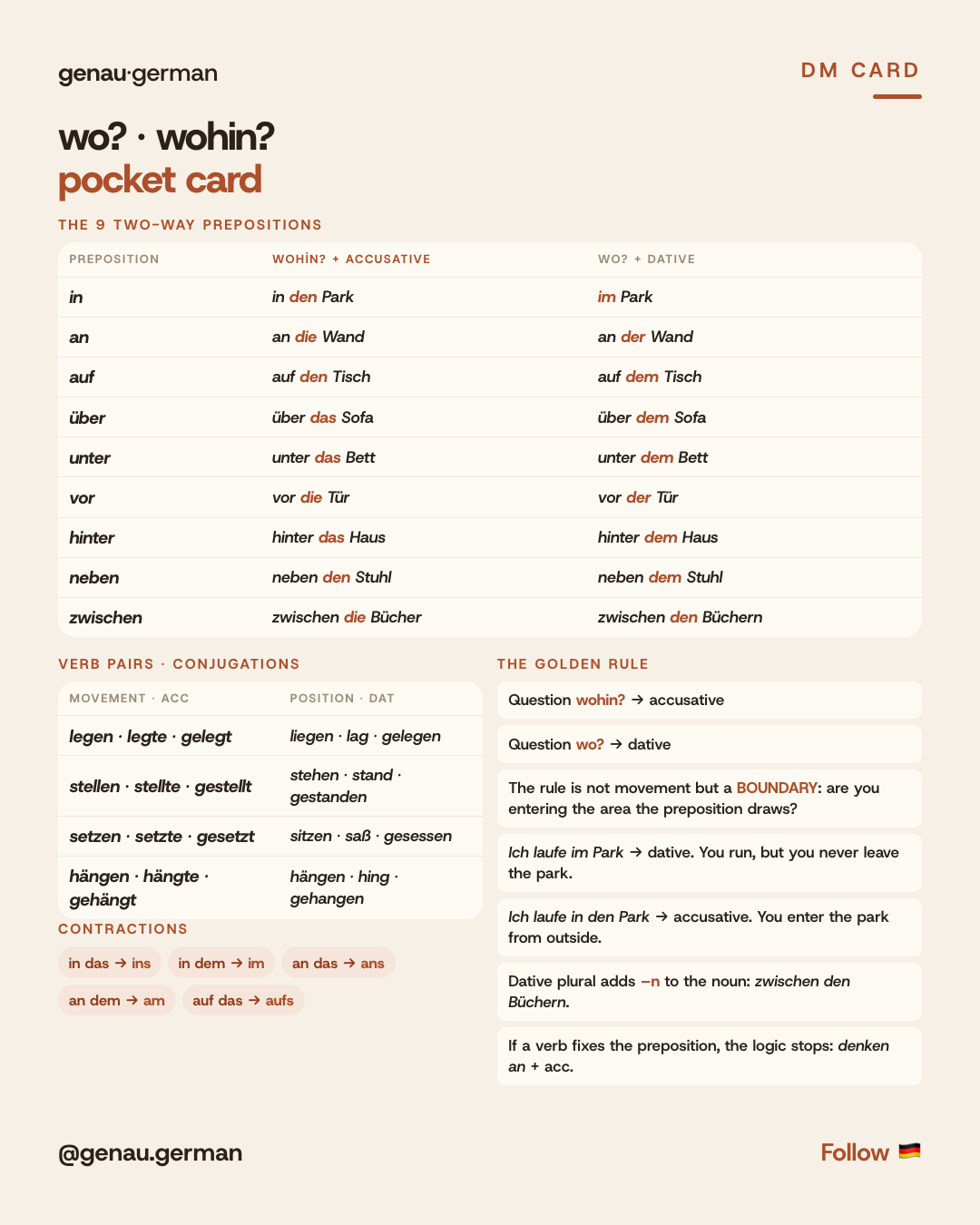
Wechselpräpositionen pocket card
The whole topic on one page. Save it to your phone and scan it before the exam.
Related topics
Akkusativ & Dativ
the full article table
Accusative vs dative: what actually changes, and what never moves at all.
Verb + preposition
Ich warte auf dich
warten auf, denken an — the preposition a verb demands, plus wo(r)-/da(r)-.
der · die · das
read the ending, not the word
Stop memorising der/die/das one word at a time; read the ending instead.